Showing posts with label Red Sox. Show all posts

Sunday, July 3, 2022

The Final Giant Update

I have long dreamed about typing this post. 

There has not been much time for writing lately, so I am glad I have a three day weekend to crank out a post or two.  

I did not think it would take this long, but here we are with the final few cards that I needed to finish off my set of 1964 Topps Giants cards. Thank you to everyone who helped out along the way, whether you traded or sold me cards, or were just here to cheer me on. I could not do it without you.  

There are only two Hall of Fame players in this post, so lets start the post with one of them.  


Yaz is not a short-print, nor a very expensive card. The centering is a little off side-to-side, but the condition of the card is good. I like the portrait photo with him looking over his shoulder. 

Back of the card, which mentions the Raleigh Capitols. 


Yaz was actually really young here, so the Minor League write-up on the back does not feel quite as out of place. He played on the Raleigh Capitols before the team folded. Yaz had one of their more memorable seasons by an individual player. The Bulls were merged with the Raleigh baseball franchise at one point, but they do not claim their players, so the season by Yaz flies under the radar locally. It's a shame that there is not any recognition of the Minor League players from that franchise.   

A common theme amongst the final players posted here, I learned a lot about players I knew little about.  


I only own one other John Romano card, which is a 1967 Topps card of him on the Cardinals. I am not going to post it here, but he has some combination of a 1950s flattop and slick-backed hair all rolled into one picture. He's wearing a sleeveless vest uniform, which I had long attributed to the Reds, but now know it's an Indians jersey. 

Romano was actually a really good player for a time in the 1950s and 1960s.  


Romano was a good hitting catcher with pop who made a few All-Star games playing for the White Sox and Indians. He ended his career with the 1967 Cardinals as the backup catcher behind Tim McCarver.  He was not on the Postseason roster, but still spent the season with the team.  

Next, Red Sox pitcher, Dick Radatz.  


The front of the card is a little worn, but I am going to live with it. 


Radatz played in the wrong era. He was a gigantic person who threw really, really hard. He played in a time where relief pitchers were minimized. Radatz struck out a ton of batters and led the American League in saves twice. He seems like he would fit in really well with modern baseball better than the 1960s.    

The second Hall of Famer in the post.....


I know Aparicio spent the second half of his career with the Orioles and Red Sox, but he's a player I always associate solely with the White Sox. It's jarring to see him on a non-White Sox card. Sort of like those Dale Murphy cards where he is on the Phillies or Rockies.  


I really like the back of this card. The entirety is spent on his Major League career and does a good job of focusing on his strengths as a player, which were stealing bases and playing defense.  One of the better write-ups in the set. I even like the small black and white photo of Aparicio sliding into second base.  

Next,Tigers pitcher, Dave Wickersham.  


He actually passed away last week while I was drafting this post. Wickersham was 86. 

Wickersham had an interesting career. 


As stated on the back of the card, the Tigers thought enough of him that they traded Rocky Colovito to the A's to add him to their rotation. He was a middle of the road pitcher with the A's, but was great for the Tigers in 1964. Wickersham won 19 games that season and was ejected in the seventh inning of his final start with the game tied 1-1 in the 7th inning pitching for his 20th win.  

The Vintage Detroit blog did a good write-up on the incident.  

Wickersham did not do much after 1964, but did end up with the expansion Kansas City Royals for his final season, making him one of three players to appear for both the Royals and A's in Kansas City.  The window between the A's moving (1967) and the Royals starting (1969) was narrow enough its surprising that it was not a more common occurrence.  

Next up, Albie Pearson.  


I was not overly familiar with Albie Pearson before tracking down this card, but I do like the picture on the front of this card. It's got to be a Spring Training photo with the mountains in the background. The Angels train in Arizona.  
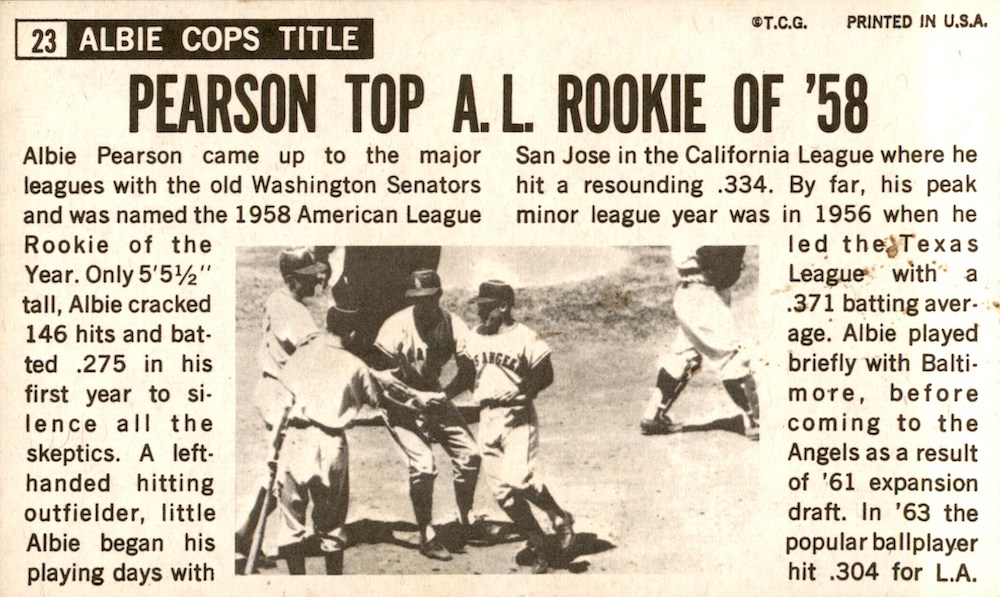


I like that they mention his height and weight. After looking him up, it seems that he was most notable for being a really small person playing professional baseball more than any single event or season. I tried to see if I could find an Albie Pearson and Frank Howard picture, or some other really huge player, floating around on the internet. Something similar to the Jose Altuve and Aaron Judge photos that pop up everywhere when the Astros and Yankees play.

I found nothing, so here is Aaron Judge and Jose Altuve. I am sure Frank Howard and Albie Pearson would have looked the same.   


Maybe taking pictures of extraordinarily tall players next to extraordinarily short players is more recent phenomenon.  

Next up, "The Turk". 


Farrell was a tall, hard-throwing relief pitcher for the Dodgers and Phillies for the majority of his career. However, the expansion Colt 45s selected him in the expansion draft and used him as a starting pitcher. He had some good years as a starter, but he later returned to the Phillies as a relief pitcher to end his career. Nice portrait photograph on the front of the card. 
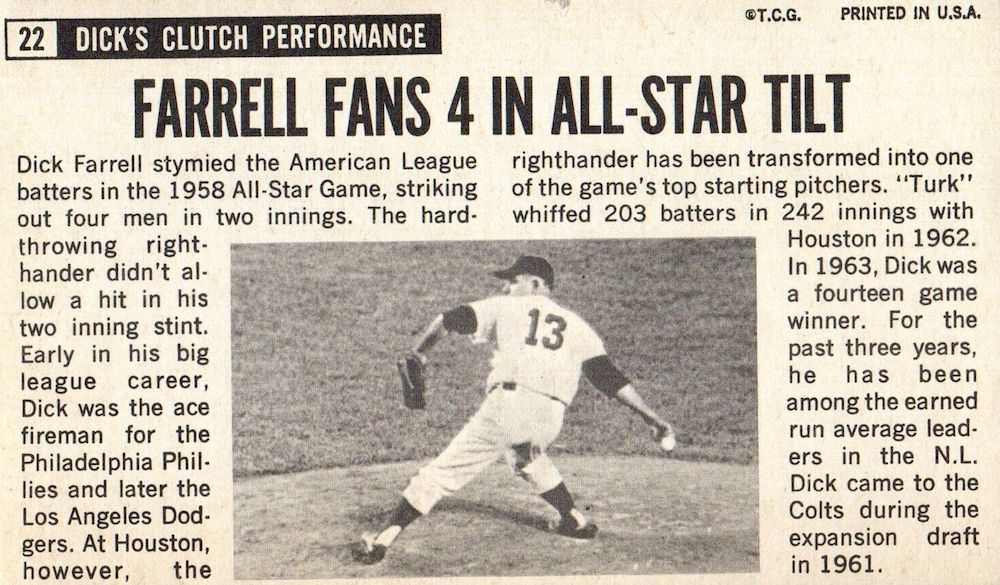


The centering on the back of the card isn't great, but I am going to live with it for the moment. The back describes his All-Star appearance in the 1958 game, which I thought was likely to be his career highlight.  It turns out that he actually ended up making the National League All-Star team 5 different times. Four of those were with the expansion Astros, so it could be that he was just the best player on those teams.   

Farrell's son, Richard Dotson, played for the White Sox in the late 1970s and 1980s. 

Another player I did not know much about.....


Chuck Hinton.

You should know this guy.  

He is actually a local player who went to high school in Rocky Mount, which is about an hour east of Raleigh. Hinton went to Shaw University, a small HBCU in Raleigh before he got drafted into the Army for Vietnam. Hinton had a late start to his career, reaching the Majors at the age of 27, but he was a good player for a short time. At the peak of his career, Hinton was a 20 steal, 20 home run player.  

Most importantly, Hinton founded the Major League Players Alumni Association after his career. There are people who, rather convincingly, argue that he is a person who should be in the Hall of Fame as a contributor to the game for starting up the Players Alumni Association. As the argument goes, he is likely tied to Curt Flood for admission into the Hall.  


Here is the back of the card, which spends most of the time talking about his Minor League career.  

Two cards left.  


Dick Ellsworth played during the 1960s, decent pitcher, but was always on the wrong teams. I kind of feel bad for him when I run into his cards. In 1963, Ellsworth went 22-10 for the Cubs. However, he also had a season where he went 9-20, another where he was 8-22. Not his fault. At one point in the late 1960s, Ellsworth ended up on the Red Sox. Otherwise, his career was spent with the Cubs (not good), the Indians (not good), and the Brewers during their first two years of existence (not good).   

Ellsworth played thirteen years and his career record is 20 games under .500. He also has a career ERA of 3.72. If he had been on good teams, you can imagine his career would have been a lot different. People who argue that wins is a misleading statistic sometimes use Ellsworth's career as an example. Decent pitcher with horrible results, largely due to where he played.  


The back of his card focuses on a one-hitter Ellsworth pitched against the Phillies in 1963. Not mentioned is the fact that Wes Covington bunted to break up the no-hitter. Also in the box score, this gem. Top line.  


The last card. 


Dean Chance won the 1964 American League Cy Young Award with 20 wins and an ERA of 1.65. He had some good seasons with the Angels and Twins, but not a very long career. He was much more noted for his off the field activities than his on the field activities at different points during his career, along with Angels teammate Bo Belinsky. After spending his 20s hanging out at the Playboy mansion, Chance spent his retirement working as a carnival operator.  


The back of the card is the standard with a short write up about a single game and a whole bunch of stuff about Chance's Minor League career.  

That's it, the entire 1964 Topps Giants set.  
Friday, January 14, 2022

A Giant Project Update #9

I am inching closer to completing my 1964 Topps Giants set. I have a few more cards to post today, including another one of the really tough short-print. I thought I would finish this set quickly, which is not happening, but at least I still have some momentum going in tracking down these cards.  

First up.  


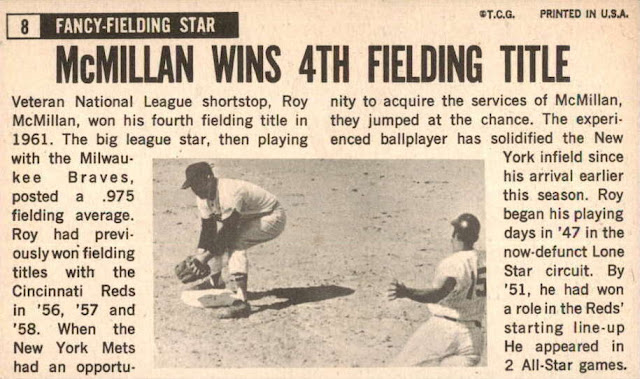
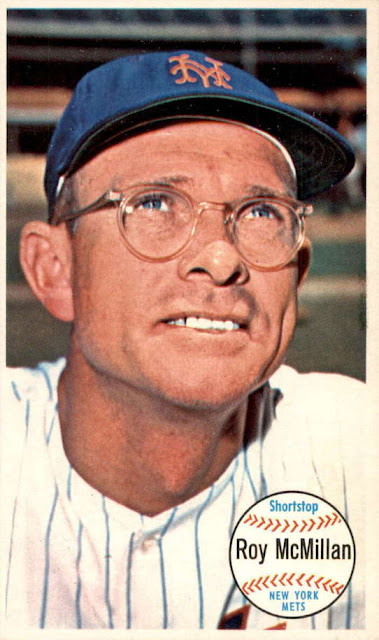
Roy McMillan looks really old in this picture, but he is only 34. I figured he was going to be 40.  However, he was at the end of his career.  If you have ever seen some of his other cards, much like Sparky Anderson, he just always looked old. McMillan was a long time Reds and Braves shortstop, one of the really great defensive players of the 1950s.  He made a few All-Star Games and also won a few Gold Gloves.  Not much of a hitter.  


The back of the card focuses on his standout defense. Many of these cards skew off onto player's Minor League careers, but the writer did a great job with this McMillan card to keep the focus on his fielding.  I like the action picture on the back. I wish I knew who the players was sliding into second base.  

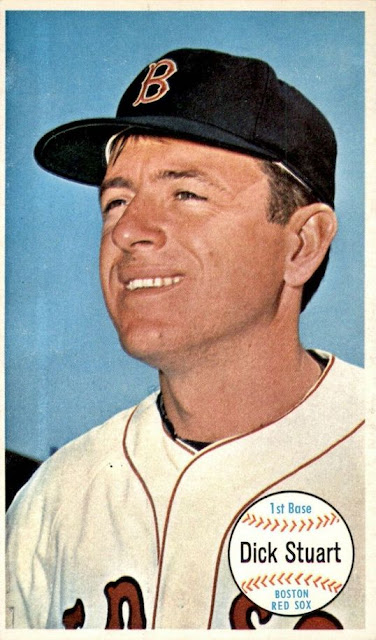
Next up is Red Sox first baseman, Dick Stuart. This is a short-printed card in the set, but I did not think it was too tough to find.  


Dick Stuart could hit.  Dick Stuart could not field.  It's the best summation I can come up with for his career.  During his prime years with the Pirates and Red Sox, he hit 30 to 40 home runs per year. He also led all first baseman in errors almost every year he played. Red Sox pitcher Dick Raditz once suggested that he get a vanity license plate for his car that read "E-3".  


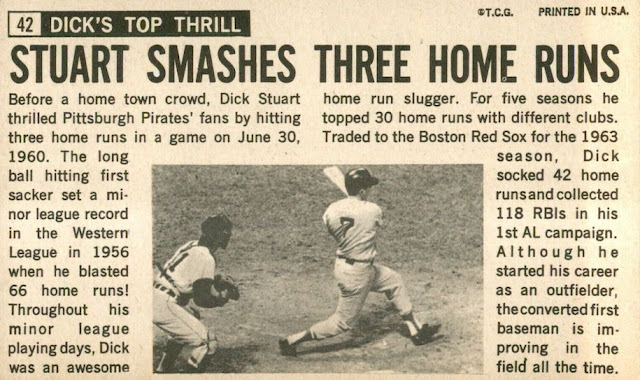
The back of the card starts out by mentioning a three home run game he had for the 1960 World Champion Pirates team. The author does manages to squeeze in a line about his Minor League career, which again is done throughout the set. That last line on the back is something. I am sure many pitchers on the Pirates and Red Sox would strongly disagree with that statement.  

Next up is a pretty good card.  


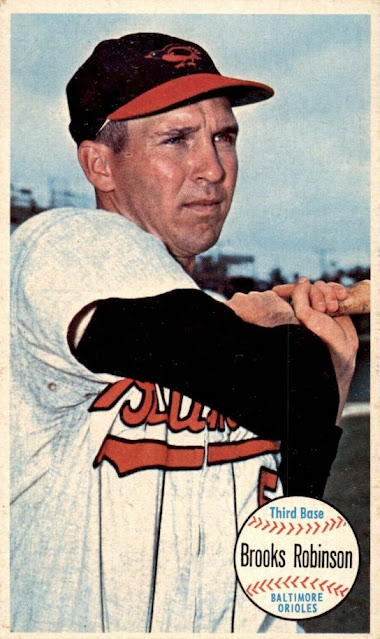
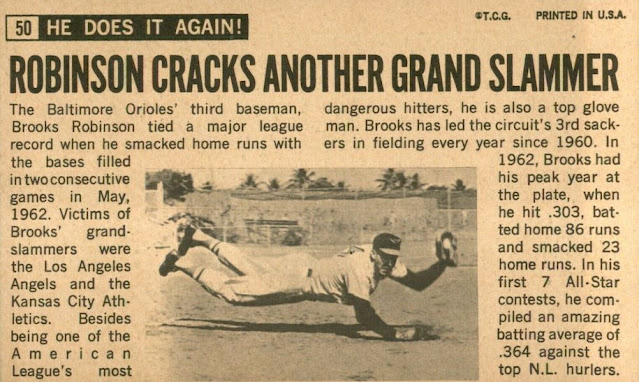
I like this portrait photo of Brooks Robinson, but it would have been nice to get something where he is fielding or standing with his glove. Although, he actually was a decent hitter at this point in his career.  Plus, the picture on the back of the card more than makes up for the photo on the front.  


Now, this is a great staged fielding photo. Outstanding. The write-up does not involve his Minor League career. Nice card, but let's get to the best card in the post.  

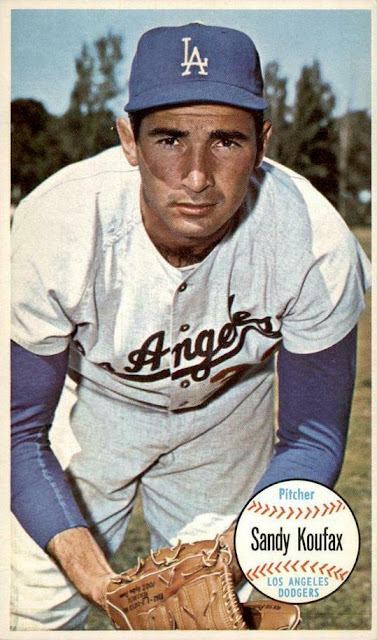
I will let the card do the talking here.  


The centering is off slightly going left-to-right and top-to-bottom, but the rest of the card is fairly clean. 


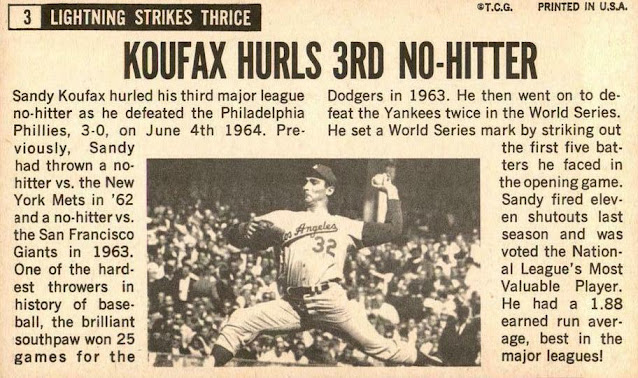
The back is a little yellow too, but this was a really tough card.

I know I stated in an earlier post that I thought the Mantle was going to be the biggest challenge in completing this set, but I think I completely underestimated this Koufax card. Again, it is short-printed and seems to be the toughest out of that group of cards.  


With the 4 new cards, I now have 33 out of the 60 cards needed to finish the set. I have two short-printed cards remaining with one of them being Willie Mays.  I am going to try to knock out a lot of the common cards over the next two months. More updates to come....

1 Gary Peters
2 Ken Johnson
3 Sandy Koufax SP
4 Bob Bailey
5 Milt Pappas
6 Ron Hunt
7 Whitey Ford
8 Roy McMillan
9 Rocky Colavito
10 Jim Bunning
11 Roberto Clemente
12 Al Kaline
13 Nellie Fox
14 Tony Gonzalez
15 Jim Gentile
16 Dean Chance
17 Dick Ellsworth
18 Jim Fregosi
19 Dick Groat
20 Chuck Hinton
21 Elston Howard
22 Dick Farrell
23 Albie Pearson
24 Frank Howard
25 Mickey Mantle
26 Joe Torre
27 Ed Brinkman
28 Bob Friend SP
29 Frank Robinson
30 Bill Freehan
31 Warren Spahn
32 Camilo Pascual
33 Pete Ward
34 Jim Maloney
35 Dave Wickersham
36 Johnny Callison
37 Juan Marichal
38 Harmon Killebrew
39 Luis Aparicio
40 Dick Radatz
41 Bob Gibson
42 Dick Stuart SP
43 Tommy Davis
44 Tony Oliva
45 Wayne Causey SP
46 Max Alvis
47 Galen Cisco SP
48 Carl Yastrzemski
49 Hank Aaron
50 Brooks Robinson
51 Willie Mays SP
52 Billy Williams
53 Juan Pizarro
54 Leon Wagner
55 Orlando Cepeda
56 Vada Pinson
57 Ken Boyer
58 Ron Santo
59 Johnny Romano
60 Bill Skowron SP

Sunday, November 22, 2020

Set Appreciation Post #8 - 2010 Topps USA Baseball

 I enjoyed making these Set Appreciation posts this summer, so I am going to try to get back into looking at the old sets hanging out in my closet. USA Baseball sets are always pretty small, so it seemed like it might be a good place to start back. I have been going to USA Baseball teams since 2006, so I got to see the college players in this set in person. Pretty good team, a few of the players worked out, a few flamed out. The usual with watching amateur players.  

Before we get into the set, here was the roster for the College National Team during the summer of 2010.  Players from the 18U and 16U teams were also included in the set, but I mainly buy these cards for the college kids.  


Again, a good mix of players here.   

Basic Design 

There are never any really well designed USA Baseball sets.  Most people just collect these cards for the autographs, right?  Maybe there is a good design out there, but I am just not thinking of it at the moment.  They always just seem bland with very little effort.  This one might be a little worse than some of the others.  

Here is the front of the card.  


What do you want me to say?  

Looks like it could be the design for the 2022 Topps base set.  Some squiggly lines around the border with a red, white, and blue color scheme.  I spent time looking for something that was good about the card.  I like that they identify the level of the team on the front of the card.  

That's it.  

Back of the card.  


None of the players have stats on the back of the cards, just a short write up about their playing career.  Some of the "this player reminds scouts of....", or "this player is just like........", or "this player models their game after......" tend to not age very well.  

ARod.  Albert Amora.  No.  

This was originally a boxed set.  If I remember correctly, you got the complete set along with one autograph per box.  Everyone bought these for the one autograph.  At least, I hope they did.  

I Bought This For An Autograph 

Do people buy USA Baseball cards for the base cards?  

No.  

Do people buy USA Baseball cards for the autographs? 

Yes.  

I keep repeating it.  Keep telling yourself the same thing if you are buying these cards for any other reason.   

I watch the games at USA Baseball.  I try to pick out some players that I think are going to be good, buy their autographs, and store them away for a few years.  I pulled an autograph of South Carolina outfielder Jackie Bradley Jr. out of my set.  


Solid Major League player and the 2018 American League Championship Series MVP.  Jackie Bradley Jr. was a great college player.  If he's not in the University of South Carolina's Hall of Fame, he will be before long.  Bradley helped South Carolina win the College World Series and took home the College World Series MVP.  He was awesome in college.  Bradley ended up being a first round selection by the Red Sox, so this was a pretty good pull at the time this set was released.  


Also decided to pick up an autograph of a UCLA pitcher who seemed to be a pretty good college pitcher.  Heard that this guy turned out to be fair pitcher.  Picked this up a few years ago while he was pitching for the Pirates. 

Special Guest Appearance By....The Durham Bulls Athletic Park 

The USA Baseball teams regularly use the Durham Bulls Athletic Park for their home games.  Yes, USA Baseball has their own complex a short distance away in Cary, North Carolina, but there are always a few appearances by the DBAP in every USA Baseball card set.  

In fact, most USA Baseball cards are either taken at either the USA Baseball complex or in Durham.  Here is the USA Baseball complex field.  Note the tall green screen in center field and pine trees behind the outfield wall.  


This card has a photograph taken at the USA Baseball complex.  


Green screen with trees in the background.  

Here is the Durham Bulls Athletic Park.  


Dark blue walls and dugouts.  The seats are also dark blue.   Green manual scoreboard.  Ads on the outfield walls.  

A few cards from the Durham Bulls Athletic Park.....


and a few more cards from the Durham Bulls Athletic Park.  


It's nice that Topps put all these cards with pictures from the Durham Bulls Athletic Park in this set.  

This might be the best part of this set.  

Best Cardinals Card(s) 

Not sure there are many great options here, so I went with the only two Major League Cardinals players who appeared in this set.  Neither player spent much time with the team.  

First up is Clemson shortstop Brad Miller.  He appeared for the Cardinals last season, and was about the only person outside of Paul Goldschmidt who hit at all last year.  


Miller was on the USA Baseball College team multiple years, including one where he was backed-up by Hawaii infielder Kolten Wong.  Miller has been a solid Major Leaguer, but very good college baseball player.  

Carson Kelly also appears in the set as a member of the 16 U team.  


Kelly was one of the catchers was supposed to take over the catching job from Yadier Molina before he was traded away for Paul Goldschmidt.  I believe the Cardinals originally drafted him as a third baseman and moved him to catcher after a few years in the Minors.  The picture on this card is a little odd.  He is listed as a pitcher and an outfielder, but it looks like he is playing 2nd Base.  

Not the best pair, but it's not like Topps has any control of where amateur players end up during their professional careers.  

Best Durham Bulls Player 

Mikie Mahtook was a great player at LSU.  He was an All-American and helped the Tigers win the 2009 College World Series Championship.  He ended up getting drafted by the Rays and was on the Durham Bulls a few years after that.  

Here's the card.  


This might be my favorite card. Mahtook is a player who ended up on the Durham Bulls for a few seasons, and the photograph on this card appears to have been taken at the Durham Bulls Athletic Park.  Mahtook made the 2014 International League All-Star team, held in Durham, and is a bit of a fan favorite locally.  Mikie has played a few years in the Majors, but he's never really been a regular player outside part of a year for the Tigers.  

In fact, I think he's most memorable play in the Majors was getting a home run taken away by Alex Gordon, but not before he gave the first base coach a high five. 


 It was a spectacular catch, but we have other things to talk about here.  

The Best Non-Cardinal Card 

There were a few different choices here, but I went with Francisco Lindor.  


Seemed like a pretty easy choice.  

How Does It Compare?  

Welp.  I have done a really good job of poker facing my way through this post.  I am really glad that Topps no longer makes the USA Baseball products.  Between the three major manufacturers that have held the license over the past twenty years, Topps did the worst job.  This set has a really boring design and packaging the cards as a set with a single autograph just feels a bit lazy.  

It's easily the worst set that I have posted this year.  


8. 2010 Topps USA Baseball  
4. 2001 Fleer EX 


Wednesday, October 10, 2018

I Really Hate Shopping

I really hate shopping.  Luckily, my house is in a place where I can walk ten minutes and buy most of the things that I need in life.  Driving is two minutes to most of these places depending on a traffic light.  There are two grocery stores, the post office, Walgreens, a Verizon store, a bunch of different restaurants, Lowe's (hardware store for you NC people), Target, an emergency room, etc, etc.  You get the point.

Usually, my wife does the big shopping trips in our household and I stay home and hang out with the kids.  However, the small shopping trips are all mine.  A week back I was dispatched to Lowe's to purchase playground sand.  The sand in our sandbox had been soiled by a cat.

There are actually many cats in my neighborhood.  We have a person in our neighborhood who feeds stray cats.  They come for miles.


At one point this summer she even tried to crowd source a vet bill for a stray who had been bitten by a snake. 

I bought the playground sand, but ended up being dispatched to Target for a few art supplies for a school project my son was working on.  Lowes and Target are right next to each other.  Didn't even have to move my car.  Now, I am not usually a retail card person, but sometimes I dabble.  I dabbled with three hanger packs of Topps Archives.  

The aisle was dominated by a bunch of Panini stuff.  I would have actually preferred seeing some Heritage High Numbers cards.  

The base cards out of Archives are the usual stuff out of that product.  Three different past card designs with both current and former players.  The best base card that I found was A's pitcher Daniel Mengden.  


I saw him pitch for the USA Baseball college team while he was at Texas A&M.  That mustache is incredible.  I know there are other cards of Mengden and his mustache, just like this one with the posed shot.  Pretty sweet.  Heard there is one in Heritage High Numbers too.  

So, what else did I get?  You know it has to be pretty good since I never blog about retail cards.  

Somehow I also managed to land two autographs in three hanger packs.  I consider anything beyond basic inserts and base cards out of retail packs to be something pretty special.  Maybe I am wrong and the odds are better now.  Still happy.  

First autograph.....


belongs to 60s and 70s Red Sox infielder Rico Petrocelli.  His career was not very long, but some of his prime years were excellent.  Hit for power, had a decent average, drove in runs, and was also an excellent defender.  

Second autograph......


to long time Braves and Mets infielder Felix Millan.  I was actually a little bummed to see that this card was a redemption, but then there are actually live copies on Ebay.  It's a Mets card on a 1977 design.


Very nice looking card.  I have not even tried to send in a redemption card in a few years, but this one might be one that I take on, especially if there are live copies of the card already available online. 

I really hate shopping, but every once in awhile nice things happen while I am at the store.   

Monday, January 22, 2018

I Love The 1990s Cardinals Part 19 - Rich Gedman

Every baseball team needs a backup catcher.  In 1990,  the Cardinals had their highly regarded prospect Todd Zeile behind the plate and defensive stand out Tom Pagnozzi on the bench.  The following off season the team moved Zeile to third base to get him out from behind the plate and give Pagnozzi a chance to start.

There was not a good Minor League option at that time, so the Cardinals signed long-time Red Sox catcher Rich Gedman in February of 1991.

Always loved his 1986 card.


Gedman's best years in professional baseball were in the mid 1980s starting in 1984.  He showed the ability to hit with power, ending the 84 season with 24 home runs, 26 doubles, and 72 RBIs, to help the Red Sox win 86 games in a tough American League East.  Gedman was also a good defensive catcher while he was playing in Boston.  His on-field performance helped him earn a spot on the American League All-Star team in 1985 and 1986.

By the late 1980s Gedman was hitting in the low .200s with no power.  The Red Sox traded him the the Astros, where he played 39 games in 1990.  Houston did not resign him and he landed with the Cardinals as a free agent.

I am not even sure how the Cardinals kept Gedman on the roster for both 1991 and 1992.  There have been players cut for far less hitting than Gedman did in his two years for the Cardinals.  In 1991 he hit .106/.140/.213 in 46 games.  Seriously.

Bob Tewksbury, pitcher, hit .155 that season.  Bryn Smith, pitcher, hit .246 with 8 RBIs which tied Gedman.  Omar Oliveras his .226 and Rheal Cormier hit .238.  You get the point.

Gedman actually improved the next season when he returned to the Cardinals.  Having him on the roster was a bad idea in 1991, not sure how he was on the roster in 1992.  Gedman ended the season with a .219/.291/ .286 slash line.

So, on to the baseball cards.  Not even sure how there were Gedman baseball cards in a Cardinals uniform, but I managed to narrow down to a final two cards.  Yes, there are several.

First up is a 1991 Leaf card.


I like the grey border on these cards.  Really simple designs are nice sometimes.  Plus, Rich Gedman is on the card.  I get the 1991 cards were based on his numbers the previous season with the Red Sox and Astros, but those were nearly as bad as the numbers he had as a Cardinal.

Last card.


Not only did Gedman get a baseball card for hitting .100 during a season, it's actually in a nice set.  If only Fleer were not bankrupt these days, we could ask what got Gedman into the set.

106.

Blake Snell number 106 is just a red herring to make two other announcements.      Announcement #1- I have not written very often in this sp...