There are some really good baseball channels with short videos on YouTube that occasionally provide me with good background while I am doing my school work at night. I ran across one a few week's ago about former Blue Jays and Angels relief pitcher Mark Eichhorn. You can find the video here.
Interesting career.
In summation, Eichhorn came up with the Blue Jays in 1982 and failed miserably. He went back to the Minors and started throwing sidearm. Eichhorn also dialed back the velocity on all his pitches and became noted as the softest tossing pitcher in modern baseball. He came back up in 1986 as was the setup man for Tom Henke. Eichhorn had one of the best seasons by a modern relief pitcher with a sub 2 ERA, 14 wins, 10 saves, and more than a strikeout per inning.
Without going year-by-year through his career, Eichhorn ended up playing 11 years, mostly with the Blue Jays and Angels. If you're into sabermetrics, his WAR7 (WAR in his best 7 seasons) is equal to Billy Wagner and Lee Smith, just without the saves.
Eichhorn's career was derailed by injuries in 1995, which is where my baseball cards come in. As a middle reliever, Eichhorn has very few cards and not many with much flash or pizzaz, but after watching the video I felt like trying to find one.
Eichhorn attempted to come back with the Angels in 1996. He missed huge chunks of the season and was not very effective, ending the year with an ERA north of 5. However, he did end up signing cards for the per-pack-autograph Leaf Signature Series.
Here is the flashiest Mark Eichhorn card out there:
This was less than $2, a small price to pay for an intriguing player with a good story.
In the process of finding this card, I discovered that Mark Eichhorn actually fit into my collection quite well and I already owned a card of him outside of common cards from the 1980s and 1990s products. It turns out Mark Eichhorn was on the Durham Bulls for a season.
Deep dig into the Durham Bulls team set box:
This is Mark Eichhorn from the 1998 Durham Herald Sun Durham Bulls team set. It was a giveaway from the local newspaper. This was the Bulls first season as a Triple A team, also the first season for the expansion Tampa Bay Devil Rays. As a new franchise, the Devil Rays did not have many prospects ready for Triple A, so they signed a bunch of 30-somethings to fill out their top Minor League team.
I enjoy a good 4A player as much as the next person, but the 1998 Durham Bulls set is all 4A players, which has long made it one of my least favorites. Russ Mormon, Dennis Springer, Dave Eiland, Bob Natal, and Dave Silvestri all make appearances.
The picture on the card actually looks like it is from the exhibition the Bulls played against the Devil Rays in Durham before the start of the 1998 season. There are some grainy photographs of the game floating around on the internet.
Anyway, the presence of Mark Eichhorn and the knowledge of his career has moved the 1998 Durham Bulls set ahead other of their team sets with Aubrey Huff or Josh Lueke.
It's not Friday, but it's the effort that counts. I love a good countdown post, but I have never consistently made them. Sometimes my day job interferes with other aspects of my life.
It's Super Bowl weekend, so I am thinking about something with football.
There is a bit of a problem though.
If I had to make a post out of football cards, it would be short and feature only a few former NC State players I enjoyed watching along with a few Rams from their time in St. Louis. I might have enough Mike Glennon and/or Jacoby Brissett cards to give them their own post. I know everyone loves a good Mike Glennon card, so I am going to post one and let you know I went a different direction.
Honestly, the title was just a ruse to get people to read the post. This is actually going to be about baseball cards, but they are all of a player who was in the NFL at one point thirty years ago.
There are videos of Brian Jordan playing football on the internet, but most are over five minutes and you're not going to watch that. I am not either. Instead, here is Brian Jordan running over Gary Bennett with Vin Scully on the call.
As a former Cardinals player, I have a healthy collection of Brian Jordan cards, so it took a few minutes to flip through them all and narrow the list down to five cards and a marble.
Honorable Mention: 1997 Topps Pro Shooters Marble
Ray Lankford is also in this set, which is why I ended up with the Brian Jordan marble. The guy who was selling these insisted that I needed to buy all his Cardinals marbles if I wanted the Lankford. Pretty interesting item and they have become rather difficult to find over the years. There are currently none for sale on Ebay or COMC. Although, someone is selling a wrapper on Ebay for $18.
5. 2001 Fleer GameTime Patch Card
There are not many Brian Jordan relic cards out there, let alone ones with patch pieces. Add in the fact that this is the only set that has a Ray Lankford relic, and its always been one of my favorites. If only it were a Cardinal card. I own several copies of this card, all with different patch pieces. I need to scan them all and puzzle piece together how much of the Braves logo from his jersey I own.
4. 1998 Fleer Ultra
This is the best picture on a Brian Jordan card and it's not even close. Maybe it's silver medal to one of the cards on this list, but it is very, very good. This is one of those cards that is fifty cents on COMC and Ebay and there is no reason why you should not own it. I also own the fancy gold version, shown below, but not the ultra-fancy serial numbered version.
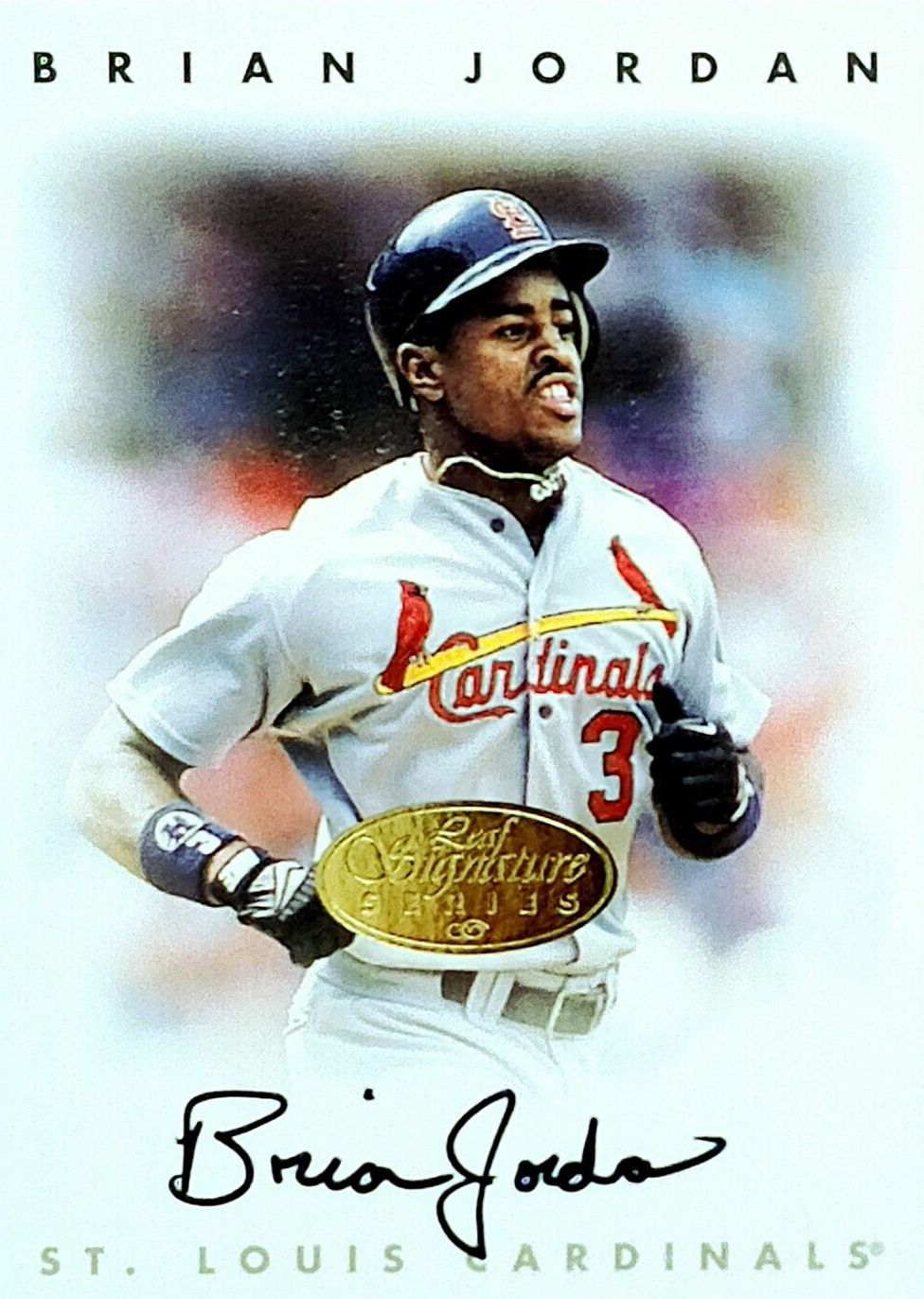
3. 1996 Leaf Signature
This was my first great Brian Jordan card, which fittingly came out in 1996. The 1996 Cardinals were a fun collection of young players from the post-Whiteyball rebuild (Jordan, Lankford), free agents (Ron Gant, Andy Benes), and Oakland A's retreads who came over with LaRussa (Stottlemyre, Eck). Also add in Ozzie Smith and Willie McGee to mix as bench players. Few remember the team coming within a win of the World Series. Lankford and Gant were better players than Jordan during the regular season, but Jordan was incredibly clutch for the team in the playoffs.
The best of those clutch moments was his series clinching home run off of Trevor Hoffman in Game 4 of the NLDS.
Jordan has also signed a bunch of cards for the Topps Archives Signature products, some of which are really nice. My favorite is this autograph on his 1997 Topps card. If I were going Top 10, this would have made it. I will add it as a mid-post Honorable Mention instead.
2. 1998 Topps
Easily one of the best Cardinals cards that Topps has ever produced for their flagship set. This is the best picture on a Jordan card, gold medal all the way. You know the Bo Jackson card where he is wearing shoulder pads with a bat across his shoulders? That's a great card, but I think this is its equal in many ways in the eyes of people who collect Cardinals cards. If nothing else, Jordan had a much better baseball career than Bo.
It's true.
1. 2000 Hologrfx Piece of the Series
Brian Jordan's lone career World Series appearance came in 1999 as a member of the Braves. He played a very well in both the NLDS and NLCS, most notably hitting a home run off of Mike Hampton in Game 3 of the first round with the Braves trailing late in the game. Had the Braves lost, they would have been down 2-1 in the Series and facing elimination on the road.
Upper Deck made a nice World Series themed insert for their 2000 Hologrfx product, which featured the stat players from the Braves and Yankees. Each player had a relic card that featured a "game-used" piece of base. Don't get me started and also an autographed parallel numbered to the players uniform number.
Super rare Jordan autograph shown above. Base insert card with base shown below.
Let's do this again next weekend. Maybe even on Friday.
There have been many Bells in baseball. There was Gus Bell, who primarily played on the Reds and Pirates in the 1950s and 1960s. That was David Bell's grandfather. There was also Buddy Bell, who spent most of his career with the Indians and Rangers.....
but also played a few years with the Reds at the end of his career. All Bells end up in Cincinnati at some point. Buddy had two sons who played in the Majors. David, who is the subject of the post, and Mike, who bounced around as a Minor Leaguer most of his career. Mike did briefly appear in the Majors, as a (say it with me)....
Red. You knew that was coming hopefully.
That brings us back to David Bell who started his career with the Cleveland Indians after being drafted out of high school in 1990. Bell made it all the way to Triple A before the Indians traded him to the Cardinals in exchange for Ken Hill. The Indians were a contender for the World Series and Hill had gone from leading the National League in wins with the Expos, to mediocre with the Cardinals. A change of scenery helped Hill down the stretch, he even pitched well in the first two rounds of the Playoffs.
Ken Hill ran into Ryan Klesko in the World Series.
The Indians lost. Meanwhile, David Bell got a chance to win the third base job at the end of the 1995 season. The Cardinals had traded for Scott Cooper before the 1995 season, but he did not play well. Bell did not play that well, but at just 22 the Cardinals got a stop gap third baseman with Gary Gaetti to start during the 1996 season.
Bell still got playing time in 1996. It did not go well. Bell got playing time in 1997. It did not go well. In 1998, Bell did not play well. The Cardinals released Bell and Gary Gaetti, and traded away Royce Clayton and Todd Stottlemyre for several players including third base prospect Fernando Tatis.
Fernando Tatis did manage to hit. David Bell ended up in Cleveland where he got some at bats playing second base. More on Bell's time away from the Cardinals in a bit. Let's look at some cards. Bell was not a good player for the team, but always managed to end up with some decent cards.
Let's start out in 1995.
We got Bell sliding into second base. Nice look at the astroturf and blue walls look of the 1980s and early 1990s Busch Stadium. Cardinals went to a grass field in 1996 with green walls. Nice action shot.
On to 1996. The first card is from the Topps set.
Not a great year for the Topps base set, and a really weird looking card. Bell looks like he is playing in game, but he is wearing a batting practice jersey. The Cardinals either wore white or grey jerseys, no third alternate jerseys. It could be the picture was taken during infield practice, but something about this card has always look off to me. At one point, I was pretty sure they just clipped a picture of Bell in front of a Busch Stadium background. Not sure that's the case though.
Next.
This is from the 1996 Fleer set. This is the Tiffany copy, which came two per pack, or something like that. Glossy finish. I like cards that have photos from Wrigley Field. That brick wall always makes a nice background.
Regular version.
Which brings us to the last 1996 David Bell card. It's autographed, it's from 1996. You know what it is going to be......
Not the best looking signature, but I believe this is his only autographed card.
1997 was light on David Bell cards, and we've already seen a Topps base card, so I am going to make this Pacific Invincible card the final Cardinals card for this post. Nice action shot of Bell hitting. While Bell played for a contending team for much of 1998, no card company included him in any of their sets as a member of the Indians. I like this card.
After leaving the Cardinals, Bell played a few different places over the remainder of his career, which lasted until 2006. He played on the Indians, Mariners, Giants, Phillies, and Brewers. His best career moment was probably his 2002 Postseason with the Giants. He hit over .400 in the National League Championship Series against the Cardinals, and over .300 with several key hits in the World Series against the Angels.
After retiring Bell worked in the Minor Leagues as a coach and manager. The last year or two, he returned to St. Louis and work with the Cardinals as a coach.
However, like all the Bells, David eventually ended up in Cincinnati with the Reds. He is the only Bell family member to not appear in a game with the Reds as a player, but the first member to manage the team.....
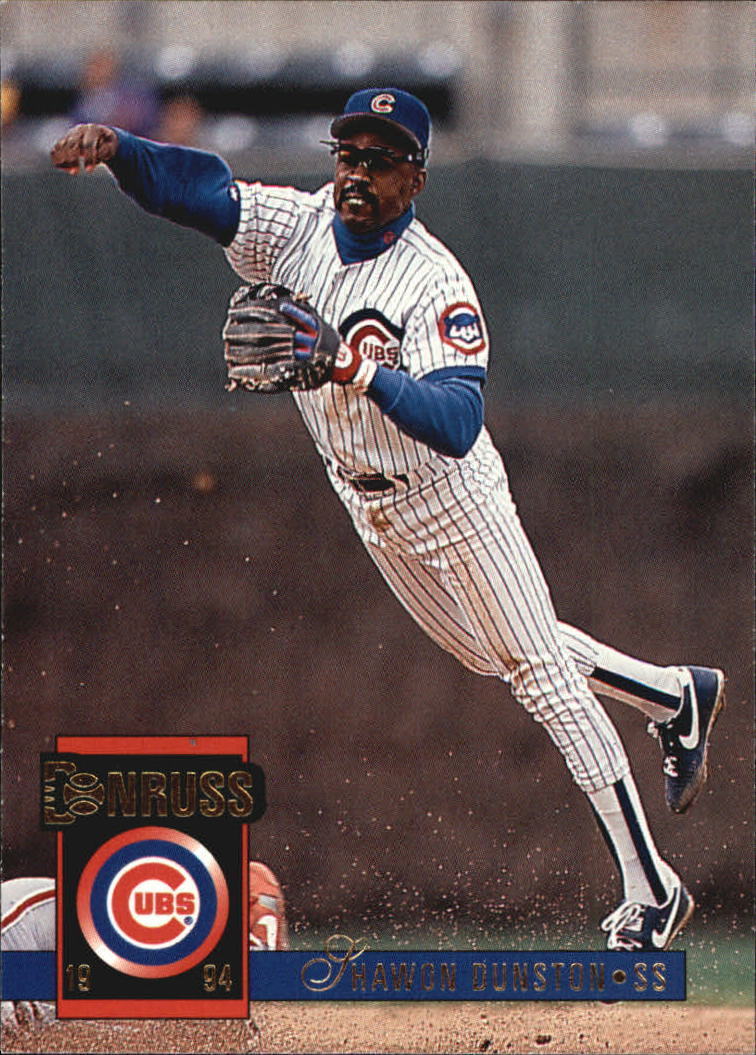
Many baseball fans who followed the game during the 1980s and 1990s probably best remember Shawon Dunston as a slick fielding shortstop for the Chicago Cubs. He was the first overall pick in the 1982 MLB Draft and arrived in Chicago about halfway through the 1985 season. For the next decade, Dunston manned the middle of the infield for the Cubs.
The vast majority of his cards in my collection feature Dunston in a Cubs uniform. Honestly, his best cards are action shots of him playing defense. I am not sure that any card companies ever got the Shawon-O-Meter on to a piece of cardboard.
This sign was a fixture in the Wrigley Field bleachers during his time in Chicago. Kind of shame it was never card worthy.
After his time with the Cubs, Dunston wandered the league. He went from the Cubs to the Giants, back to the Cubs, then off to the Pirates, signed as a free agent with the Indians, traded back to the Giants, and finally to the Cardinals as a free agent during Spring Training in 1999.
Along the way, Leaf made the best Shawon Dunston card in my collection, which showed up in 1996. It features Dunston as a Giant, that was his first stint there.
I know he has some other autographs out there. I am not sure exactly what they are, probably not going to go looking for them either. Unless I pull one out of a pack of cards. Otherwise no.
Let's get to his time with the Cardinals. Dunston only played 62 games in a Cardinals uniform during the 1999 season before he was traded to the Mets at the trade deadline for Craig Paquette. The highlight, perhaps lowlight, of his Cardinals career came later that season while he was actually playing for the Mets.
From the New York Times.....
"Shawon Dunston was oblivious to history. After Mark McGwire's 50th homer soared over the center-field fence yesterday at Shea Stadium, it bounced off a fan's glove and back onto the warning track. The ball was historic because no other player had ever smashed 50 home runs in four consecutive seasons. Dunston, who thought McGwire's scoreboard-bulb-breaking homer six innings earlier had been the 50th, scooped up a sliver of history and flipped it into the bleachers."
Dunston felt bad about the incident.....
''I thought that was 51,'' said Dunston, who was acquired from St. Louis last month. ''It was history. I felt so bad. I told Mark I was sorry.''
So, what sort of baseball cards does a 37 year old utility player get for half a season? Not much, just two team issued cards. The first was actually a part of a team set that were available at local McDonald's restaurants.
I know, it's really an Upper Deck MVP card without the brand logo up at the top of card. I have accidently sorted these cards into stacks of MVP cards in the past. The brand logo is easy to miss, the only real difference is actually a small McDonald's logo on the back.
Dunston also had a card in the baseball card set that was given away at Busch Stadium.
and that is it for Dunston as a Cardinal in 1999. However, the team brought him back in 2000 in the same utility role. The Cardinals gave him another team issued card that year, no major brand cards though.
At the beginning of 2001 several different card companies put him in their early products. However, Dunston left the team to play for the Giants. I am not sure how many different stints Dunston had on the Giants, but one of his early 2001 cards, in Upper Deck Victory, had a picture of him in a Cardinals uniform....
with Giants logos and markings on the card. His Topps and Pacific cards were actually Cardinals cards all the way around. Picture, logos, the whole enchilada. The Pacific card....
\
with a picture in Wrigley Field. Well done Pacific. I wish you were still a card company.
and his Topps. Is this card in Pac Bell? Feels right that even his non-Cub and non-Giant cards still appear in their stadiums. It's also not every 1990s Cardinals post that I venture into the 2000s, but there are so very few Dunston cards with the Cardinals, especially considering he's a fairly well known player and he had two different stints with the team.
The beginning of Joe Magrane's career with the Cardinals was more successful than many baseball fans remember. He started the seventh game of a World Series, won an ERA title, led the National League with a 161 ERA+, had a top 5 Cy Young Award finish, and nearly led the NL in wins one season too.
That was just his first three seasons.
The Cardinals selected Joe Magrane in the first round of the 1985 MLB Draft with the eighteenth overall pick out of the University of Arizona. He quickly made his way through the Minors in a year and a half, making his Major League debut with the 1987 Cardinals. As described above, his first three years in the Majors were great. Everything you could hope to get out of a first round draft pick and more.
If you look through a stack of Joe Magrane baseball cards you will probably notice that half of his cards are all-star cards and the whatnot from 1990. Magrane was a serious contender for the Cy Young in 1989 and probably should have led the League in wins.
He had a Diamond Kings card.
I should have prefaced the statements above by saying that he was all of those things, Cy Young contender, before the month of September. The Cardinals finished that month below .500 and probably cost Magrane all of those individual awards. It was brutal.
Here's another card commemorating 1989.
During the months of July and August Magrane went 11-1 and entered September with a 18-7 record. He started six games during September and he walked away with an 0-2 record for the month. Magrane's last two starts of 1989 were a seven innings of shutout pitching, five strikeout, but a no decision to the Phillies. His last start was a seven inning, one run allowed loss to the Pirates. So, that's 15 innings with 1 earned run and he recorded a loss out of those two games. Just terrible.
This was the season that the Cy Young Award was given to Padres reliever Mark Davis. Sigh.
Magrane still got all of these All-Star cards out of it.
So, this is a 1990s Cardinals post, so we should move on and talk about something outside of Magrane's 1989 season. To start the 1990 season, Magrane went 0-6. The Cardinals were terrible that season, but it's not like they let him down. Magrane was really mediocre. You put mediocre on a last place team and you get a 10-17 record.
Towards the end of the 1990 season he hurt his elbow and lost nearly two years. All of the 1991 season and most of the 1992 season. The Cardinals brought him back in September of 1992, sort of a late season, in-season, addition to the club. He did not pitch well.
Magrane still got a few cards during these years.
Like all early 1990s players, one of the best places to find some good cards is in the Stadium Club sets. Magrane has a bunch of studio style pictures on his 1992 and 1993 cards from this product. I really prefer his 1991 card, which shows him pitching in a game.
His 1992 Topps card is similar, but with more action.
Back to his career.
The Cardinals kept Magrane around for the first half of the 1993 season, but eventually released him. Magrane ended up signing with the Angels where he played out the 1993 and 1994 seasons. The Angels cut him towards the beginning of the 1995 season, after which he bounced around the league for a year signing with the Cubs, Expos, and White Sox.
The White Sox were the only team that ran him out there to pitch a few games. It did not go well, but he did get an autograph in Leaf Signature, who didn't, for appearing in a dozen or so games.
While his career on the baseball field did not really go as planned, Magrane has made a nice name for himself around sports as a broadcaster. He has worked for the Rays as a play-by-play announcer, NBC during the 2008 Olympics, but more recently has worked as a commentator on MLB Network.
Not the most notable Cardinals from the 1990s, but still a memorable player. Especially for his efforts during the 1989 season.
Going with the Carolina League version of the Durham Bulls for this post. Nieves was signed out of Puerto Rico by the Braves in 1988. The former Major League outfielder signed as a 17 year old, so it took him a few years to reach A-Ball with the Bulls. Nieves first stint with the Bulls was decent, but as a 19 year old, the Braves left in with the Bulls for a second season. It lasted all of 31 games. During that short stint, Melvin Nieves hit .302/.395/.632 with 8 home runs, 9 doubles, and 32 RBIs. The Braves shuffled him up to Double A, and eventually for a cup of coffee in the Majors at the end of the season.
Shortly afterwards the Braves took advantage of his great season trading him to the Padres in exchange for Fred McGriff. It was not a 1 for 1 trade, but Melvin Nieves was the most significant player the Padres received. He ended up as a Top 100 Prospect with Baseball America in both 1993 and 1994 and continued to hit in the Minors after the trade. The Padres called Nieves up for good in 1995, but he only hit .205 and had almost 100 strikeouts in just 234 at bats. San Diego eventually traded him to the Detroit where he had two 20 home run seasons. His final Major League took place with the Reds in 1998. Nieves eventually ended up in Japan for a few seasons before returning to MLB for a comeback attempt with the Nationals in 2005. He never made it back to the Majors.
Card-
Look for an autograph of a 1990s baseball player, it seems like I always end up look at the checklist for the 1996 Leaf Signature set. The last couple of posts in my Durham Bulls autograph series have been out of this set, looking ahead, there are several more players who I could pick out of this set. Nieves is one of many instances where these large autograph sets, like Leaf Signature, are actually the only option for finding a certified autograph. While Nieves has healthy number of cards for a player who did not stick around too long, this is his only appearance in as a signer as a professional baseball player. The card is very common and very inexpensive, but I still like the looks of the card and am happy to add another autograph of a former Durham Bulls player to the collection.
Mabry worked as a hitting coach for the Cardinals in recent years under the unsuccessful and unpopular Mike Matheny. He took a lot of flack, maybe rightfully so, about the lack of offense during his time with the club as a coach. More specifically, the team seemed to lack much power. Mabry was not exactly know for his power as a player, which likely added to fans criticism of him as a coach.
Manager Mike Marheny, John Mabry.And Billy Mueller all fired from #Stlcards staff
Cardinals fans rejoiced. I am not sure if he has found another job as a coach.
The Cardinals selected Mabry in the 6th Round of 1991 Major League Draft. He made it through the Minors with little fanfare. Mabry never put together a great season in the Cardinals system, he was just sort of a solid player who happened to reach the Major League level at a time when the roster was a little thin on talent. It did not help that All-Star first baseman Gregg Jefferies left the Cardinals for the Phillies.
Mabry showed up in a few different baseball card products while he was in the Minors, but there were better Cardinals prospects to go after beyond Mabry. He appeared in an Upper Deck Minors set, also the 1994 Bowman set. My favorite early Mabry card was his 1994 Score Rookie/Traded card. Loved the red border on these cards.....
He was more or less a full time player on the 1995 Cardinals. He frequently started at first base for the team, but also made some appearances in the outfield. One of Mabry's best attributes as a player was his throwing arm. The Cardinals had a crowded outfield though with Ray Lankford, Brian Jordan, and Bernard Gilkey taking up the majority of playing time.
I think there are several 1995 cards that do a good job of summarizing Mabry's offense skills.
A Collector's Choice card with a picture of Mabry throwing the bat. He did hit over .300 in 1995, which is something positive. Mabry also came in fourth in the Rookie of the Year voting.
Look at that check swing. Mabry also only hit 5 home runs, which seems borderline criminal for a corner infielder. His slugging percentage was .405, which sadly ranked just behind the aforementioned starting outfielders. He often occupied important places in the line-up, but probably would have been a seventh or eighth place hitter in many other lineups.
One of his highlights from 1995 was a fake bunt walk off hit against the Cubs.
If you want to understand how bland and boring Mabry was a player, I think it is best exemplified by his Emotion card from 1995. These cards had adjectives stamped on the side of the player's picture which was a description of their style of play. Mabry's word.....
Adroit, meaning skillful, is a way of saying he shows up and he puts his jersey on the correct way. I am not exactly sure in what way Mabry showed that he was adroit. Really, it probably made people go grab a dictionary or thesaurus.
Seriously, he looked nice on a card or two. Like his Flair.....
That's a good look for Mabry. He just hit a single.
John Mabry's best season was probably 1996. He just missed hitting .300, had 13 home runs, 30 doubles, and drove in 74 runs. In the Postseason, he hit .300 against the Padres in the Divisional Series and .261 against the Braves in the National League Championship Series. Mabry also had his best baseball card made, which appeared in the 1996 Leaf Signature product.
Mabry has some oddball autographs from early in his career, but this is his best autographed card available. Probably his best card overall too. I am not a huge fan, if you could not tell, and if I did not need the other cards in the post to complete sets in my collection, this would likely be one of my only Mabry cards.
There were a few cards of Mabry during the 1997 and 1998 seasons, but his role on the club was rightfully diminished after the team signed Ron Gant and traded for Mark McGwire. The two moves made it hard for him to find playing time as an outfielder or on the infield. The Cardinals played around with making him a third baseman, but that did not work out well.
My favorite 1997 card of Mabry was his Stadium Club. He's fielding in this picture, but I like the action shot in Wrigley against the Cubs. That park always makes for a great baseball card backdrop. Having the Cubs player being Ryne Sandberg also probably helps too. Great photo, exactly what you would expect out of a Stadium Club card.
Mabry was non-tendered by the Cardinals after the 1997 season and ended up playing for the Mariners in 1998. He still had a few cards with the Cardinals in 1998 though. My favorite is his Topps card, which shows him fielding a ground ball at first base.
The rest of Mabry's career was spent on the bench bouncing around the league. There is always space for an extra left handed bat. Mabry would reappear for the 2001, 2004, and 2005 Cardinals teams. In between he played for the Mariners, Padres, Marlins, Phillies, A's, Cubs, and Rockies. There were not a ton of baseball cards to commemorate his second and third stints with the Cardinals. Those that were made were rather.......