Showing posts with label Chris Carpenter. Show all posts

Friday, May 15, 2020

Bowman Season

Topps brought Bowman back while I was in late elementary school. I really enjoyed the cards outside of the fact that they did not fit very well into plastic sheets.  I did not buy any special sheets or boxes, and it's pretty easy to flip through my 1989 Bowman cards and figure out the ones I actually opened in 1989, versus the ones I have opened later in life. I love them still the same. 

My best memory of the 1989 Bowman set was pulling my first Ken Griffey Jr. rookie card.


Great card.  Really underrated in my opinion. 

In the 30 years since I opened my first pack of Bowman cards, I have generally enjoyed this product.  There were some blah years during the early 1990s where it felt like a second Topps base set, but I even enjoy looking at those cards from time to time.  For example, the time that Topps squeezed a Jamie Moyer Cardinals card into the 1991 set.


Not the finest moment of his career, and not many cards were made of him wearing a Cardinals uniform.  

When Bowman transitioned to being a prospect heavy set in the mid 1990s, I played along and found all of the cool rookie cards.  I watched the Cardinals, and did not know much about Minor Leaguers at that point, but I learned.  If nothing else, I would find cards of the Cardinals prospects.  I have all my favorite Redbirds from the 1990s and early 2000s who had really good Bowman cards.  

Scott Rolen.  


Chris Carpenter.  


Albert Pujols.  


They made Bowman spin offs like Bowman Chrome.  Yep, got those too.  


Another good 1990s Cardinals player.


Eventually, I even picked up the really popular rookie cards, like Vladimir Guerrero that I did not pull out of packs, or buy at the time the Bowman product for the year was released.  


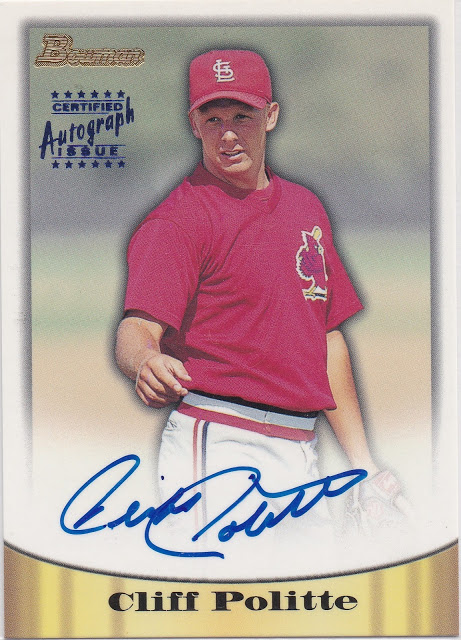
Bowman Autographs.  Huge fan.  


I have always had a soft spot for the 1997 Bowman Lance Berkman card where he is standing by the old pickup track in front of the AstroDome.  Got to fit this card into the post.


Yes, it took money to buy Bowman cards, but they were a reasonably priced pack of cards.  It was a set you could assemble on a budget.  When players did not pan out for whatever reason?  


Who remembers Matt Anderson?  Nobody spent a small fortune on his cards, at least I do not think they did.  Probably not.  

I loved Bowman, but they feel different now.  How does someone go from thorough enjoyment of a baseball card product to annoyance and negative feelings?  I would like to point a finger squarely at the Steven Strasburg craze in 2010 as the starting point. That entire summer was filled with baseball card people going crazy over packs of Bowman cards, Strasburg autographs, and all the different parallel cards.


Can I buy Bowman cards at Wal-Mart and Target?  Normally, the answer is yes, but not the summer that Strasburg rolled around.  I think I ended up buying a box from someone online, but was highly annoyed that it was more expensive than normal.  At some point that summer, I was booted from a Facebook Baseball Card Group for rejecting a trade that involved me taking a Strasburg autograph and giving up autographs of Stan Musial, Ernie Banks, and Yogi Berra.  

I regret nothing.  

I saw Strasburg pitch at USA Baseball when he was at college, seemed like a pretty incredible talent, so I am not sure I could really fault people for being all in on finding his cards.  There has always been that sort of feel with Bowman since the late 1990s, it just seemed to go to the next level with Strasburg. I was hoping it would be a one year phase.  

It was not.  

The craze over Bowman has continued since, in what feels like a now annual event.  There was the Bryce Harper year, something about Kris Bryant, some other people I am not remembering off the top of my head, Wander Franco, and now we are on some kid from the Yankees who has not even played a game stateside.

I am not even going to touch a pack of Bowman cards this year.  

I may not even touch a loose single Bowman card this year.  

To me, there is simply no enjoyment in this product anymore.  I can basically narrow my dislike of Bowman down to two different factors. 

1. Money 

Money for baseball cards is finite in my world, and Bowman has become pricy.  I am not going to screen shot some baseball card stores site for this post, but they are generally selling jumbo boxes in the neighborhood of $400.  That's quite a price hike from what they normally cost.  There are better ways for me to spend my baseball card budget.  

I could buy 20 of those Project 2020 cards.  I should have bought 20 copies of the Bob Gibson card with the pirate hat.  


I recently went through a whole boat load of sets looking for missing cards, finding them on COMC or Sports Lots, and dragging them into my shopping cart.   I could finish off roughly two dozen partial sets in my card closet by buying 140 some cards off of the two sites.  My cost was less than $100 before shipping.  

That's the plan I am going with for the rest of my CoronaCon vacation.   

2. You Don't Know.  I Don't Either.  

Nobody knows what players from this year's Bowman set are going to be good ten years from now, but there are going to be plenty of people who spend a small fortune trying to guess.  That feels like a big waste of money.  

I frequently question whether people who spend a lot of money on Bowman cards actually pay attention to the number of Minor Leaguers who reach the Majors, what happens to them when they get there, and the chances of that player fulfilling their definition of the word great.  I have my doubts.  

Take the Strasburg draft.  The best player in the draft, Mike Trout, did not get taken until the 25th pick right after Randal Grichuk.  Besides Strasburg and Trout, the players with the best career numbers taken in the first round are A.J. Pollock, Mike Minor, and Mike Leake.  That went downhill quickly.  What did Mike Leake cards sell for in 2010? 


Who wants to go back to 2010, and spend a whole bunch of money buying up the Mike Trout cards?  


Bowman story time.  Gather round on the carpet.  Let me tell you about the time when I pulled the best autograph from a Bowman box, which is now borderline worthless, but one of the other autographs that was worthless at the time is really popular and expensive now.  It shouldn't be.  It's a good story.  

Everyone ready?  

In 2014, I went to some sort of half day training in a part of Raleigh that was near my card shop of choice at the time.  I miss Big D's Card Shop, great store. It was Bowman release day, so rather than taking a lunch break, I went and got a pair of Bowman boxes to open.  Food can wait. I opened my packs of cards, and got to hang out and talk to the store owner.  Best thing was that I got the best autograph possible.  

Look at this thing.


Mark Appel was the first overall pick in 2013.  He was going to be a great player.  In reality, I   probably should have scanned it in the card shop, and sold it that day.  I did not.

I was excited. 

I took it home, put it in a penny sleeve and a top loader.  The thing was going to go to from being a really good Bowman autograph to being a great Bowman autograph.  At least, that's what I told myself at the time.  It is still sitting in a box full of autographs.  Bet I might get $5 for this card on a good day.

Who were my other autographs?


Some Reds outfielder who was hitting sub-.250 in the Pioneer League, which is half season A Ball.  Threw this in a box.  Completely forgot about it for awhile.  Everyone has looked at his Minor League numbers, and knows Aquino is 26 and has not played a full season in the Majors?  (whispers) He didn't hit well away from Cincinnati, (whispering and mumbling) and he hit .196/.236/.382 during the last month of the season.  

I got someone to pay and arm and a leg for the card recently.  Glad these prospect collectors pay attention to numbers.  

I am already staying at home, but whenever and wherever Bowman shows up, I will be somewhere else buying cards that make me happy.  Probably some cards that actually have some reason attached to their value.  Hopefully one day we can return to the sane days of Bowman, because I would be happy to enjoy these cards again.  

Sunday, April 14, 2019

Weekend Countdown: Topps Total Cardinals

Long ago, two years ago, I used to do a countdown on this blog space every Friday.  That's kind of a busy day of the week in my world, which is why the "Friday Five" has slowly disappeared over that time.  I still like the idea of having a countdown post, so I am going to try something a little different, and see if it sticks a little better.

Here's what I am shooting for:  


  • One countdown post per weekend 
  • The countdown is not going to be defined by a number, not 5, not 10.  I choose it when I get there 
  • Sticking with cards, not stats and numbers.  Maybe an occasional pop culture type of post.  


Here is my first Weekend Countdown: 


So earlier this week, Topps tweeted out.....


which made everyone correctly speculate that Topps was bring back their early 2000s behemoth Topps Total.  It was 990 cards with roughly 30 cards per 30 Major League teams.  The product was affordable, and the ultimate challenge for set collectors.  I am not sure if I have ever actually finished a Topps Total set, but I at least have the Cardinals cards completed.

The boxes are still really cheap, so.....

There are actually some interesting Cardinals cards in the Topps Total sets, so I thought I would pick out a few of my favorites for this week as my first Countdown subject.


5. Eli Marrero - 2003 Topps Total Signatures 

Marrero appeared in all three Topps Total sets, all with different teams.  The Cardinals in 2003, the Braves in 2004, and the Royals in 2005.  This was one of Marrero's last Cardinals cards, as he was traded away to the Braves for Adam Wainwright. He is also the "best" Cardinals autograph that you can find in a Topps Total set.  His competition is Jimmy Journell. 


4.  Jason Motte - 2005 Topps Total 

I like Jason Motte rookies.  He is one of those players who started out doing one thing, and ended up somewhere else.  The Cardinals drafted him as a catcher, he could not hit anything, but he had an incredible arm.  You probably best remember Jason Motte for this......


It was a successful position change.  If you have not followed his career, Motte had some arm troubles with the Cardinals and has bounced around since.  Still, you pitch the last out of a World Series, you tend to get remembered.  


3. Rick Ankiel - 2005 Topps Total 

Another prospect type card from the 2005 Topps Total set.  I initially thought that this card was some sort of terrible way to help Topps fit players into the set, while maintaining the desired number of cards in the set.  There are a few cards like this in the set that stray from the prospect/prospect format and have a prospect/old guy.  Like there is an Adam Wainwright card like this with Cal Eldred.  This is Topps, so cutting corners is totally fair game.  

Nope.  

This is actually a prospect card.  Ankiel is listed as an outfielder on the card, and this is actually after he went back to the Minors and quit pitching.  Hard to keep track of all the dates with Ankiel, but he last pitched in 2004.  We can argue whether or not a 25 year old in A Ball is a legit prospect some other time, but Lambert was also an A Ball player.  They seem like they might fit together.  


2. Chris Carpenter - 2003 Topps Total 

Chris Carpenter was on the Blue Jays for a few years at the beginning of his career.  He had some arm troubles, got released, and the Cardinals signed him.  Carpenter hung out in the Minors for awhile, made his way back to the Majors, and by 2004 was in the Cardinals rotation. Between 2003 and 2004 Topps made two cards of Chris Carpenter.  Yes, the airbrushing is terrible, but this card is the first Carpenter in a Cardinals uniform.  Sort of an important recent player.  Ask a Phillies fan.  


1.  Yadier Molina -2004 Topps Total 

There are better Yadier Molina rookies, but this one still counts.  I like that he is catching on this card, as opposed to his Bowman rookie card where he is batting, and wearing a jersey with a 70 something number on the back. 


Friday, February 13, 2015

Friday Five: Cardinals Starting Pitchers

5.  Chris Carpenter

There is no doubt that Carpenter could have been on top half of the list, if he had stayed healthy during his time as a Cardinal.  The Cardinals signed Darth Carp in December of 2002.  He would spend the rest of career, he retired after the 2012, with the Cardinals.  However, he missed full seasons in 2003, 2007, 2008, and 2012.  He also missed the 2004 Postseason which might have looked a little bit different with the team's best regular season starter making starts for a team which reached the World Series, but lost to the Red Sox in 4 games.  Let's talk about what Carpenter did while he was healthy.  In 2004 he won 15 games with an ERA+ of 122 pitching in his first full season since 2001.  In 2005 he won 21 games, pitched a National League best 7 complete games, struck out 213 hitters, and posted an ERA+ of 150 with a WAR of 5.8.  Carpenter won the National Cy Young Award in 2005.  In 2006 his numbers declined slightly, but the Cardinals made it to the World Series and beat the Tigers in 5 games.  Carp's lone World Series win that year was an 8 inning, 3 hit, 6 strikeout gem which gave the Cardinals a 3-1 series lead and slammed the door on any hopes the Tigers had of winning the Series.  He missed 2007 and 2008, but returned in 2009 and pitched the best baseball of his career going 17-4 with a NL leading 2.24 ERA, an ERA+ of 182, and a WAR of 6.5.  2010 and 2011 were good seasons too, but the 2011 Postseason was the real highlight of his career.  He pitched the Cardinals past the heavily favored Phillies in the Divisional Series, the Brewers in the National League Championship Series, and the Rangers twice in the World Series.  David Freese won the World Series MVP, but I would like to think Carpenter was a close second.  


4.  Adam Wainwright 

Wainwright is still active and still only 33, so it's possible if this list is revisited in the future, that he could end up as high as the second spot on this list.  The Cardinals traded for Wainwright in 2004 when he was more or less a throw in from the Braves for J.D. Drew.  He spent his first season with the Cardinals pitching out of the bullpen and ended up the team's closer in the Postseason when Jason Isringhausen was injured.  Wainwright helped the Cardinals through the 2006 Postseason and recorded the final out of the team's 10th World Series win by striking out Tigers third baseman Brandon Inge.  The next season the Cardinals moved Wainwright into the rotation and the rest is history.  In seven seasons as a starter Wainwright has consistently been worth 15 wins, almost 200 strikeouts, and 200 innings every season.  Wainwright is not the flashiest of pitchers, and is far from overpowering, but he always seems to get the job done.  He has been an All-Star three times, but has never won any other individual awards.  Wainwright's best season was probably 2010 when he went 20-11 with a 2.42 ERA, 230 innings pitched, 213 strikeouts, an ERA+ of 160, and a WAR of 6.3.  


3.  Harry Brecheen 

Brecheen was a really important pitcher for a brief time on the 1940s and 1950s Cardinals.  Really his career had a dramatic fall off in 1950, but before that he had about six or seven years of really really good baseball.  Brecheen originally came up with the Cardinals in 1940, but then spent the 1941 and 1942 seasons in the minors.   He returned to the Majors in 1943 and split the season between the rotation and the bullpen, appearing in a total of 29 games (13 starts, 11 games finished) with a 2.72 ERA and an ERA+ of 150.  He also appeared in three World Series games that season in a loss to the Yankees.  The next six years after that were his best years which netted the Cardinals two World Series rings.  Starting in 1944, running through 1949 Brecheen won 16, 15, 15, 16, 20, and 14 games.  He won the National League ERA crown in 1948, led the National League in strikeouts, ERA+, FIP, WHIP, and posted a WAR of 8.9.  After 1949 his career had a sharp decline, but Brecheen spent three more years pitching for the Cardinals and his last year with the St. Louis Browns in 1953.  


2.  Dizzy Dean 

Dean's career was similar to Brecheen's: short, high peak, quick fall.  Jay "Dizzy" Dean first became a Cardinals regular in 1932 winning 18 games and leading the National League with 286 innings pitched and 191 strikeouts.  His next four seasons (1933-1936) netted Dean more than 100 wins, 3 All-Star appearances, a World Series ring, and an MVP award.  His best season was easily 1934, he won the National League MVP and a World Series ring, but also went 30-7 with 29 complete games and struck out a National League leading 190 batters.  In the 1934 World Series Dean went 2-1 with an ERA of 1.73.  After the 1936 season, Dean would only win 29 games the rest of career, or one fewer victory than he had in 1934.  He spent time with the Cubs in 1938, 39, 40, and 41 before disappearing and then reappearing for one game with the St. Louis Browns in 1947.  


1.  Bob Gibson 

This was not really that close.  While some of the pitchers on this list have had a good run for a brief period of time, Gibson was able to put together a great career that include a stretch of more than a decade of really good pitching.  During his 17 year career Gibby only pitched for the Cardinals and helped the team win two World Series rings to go with his two Cy Young Awards, MVP Award, and 8 All-Star Game appearances.  Gibson started with the Cardinals in full time in 1960 when he split his time in between the rotation and the bullpen.  By 1961 he was in the rotation full time where he would stay until his final season as a Cardinals when he had an unsuccessful return to the bullpen.  His best season was easily 1968 when he won 22 games with a 1.12 ERA, struck out 268 batters, and had an incredible WAR of 11.2.  Gibson was elected to the Baseball Hall of Fame in 1981 and is rated by JAWS as the 14th best starting pitcher of all-time one spot ahead of Phil Niekro and one spot behind Warren Spahn.  

Thursday, January 16, 2014

Autographs Under The Radar

I spend a lot of time looking for autographed cards and often make it no secret that I prefer cards with on-card signatures versus cards with sticker autographs.  There are still some really cool autographs out there that feature autographs on stickers.  One of my favorite sets of sticker autographs comes from 2007 UD Elements set.  I started out collecting the set in order to pick up two different Cardinals players in the set.


2007 UD Elements Chris Carpenter Auto/Jersey 


My first autograph was Chris Carpenter.  I loved the look of the set with both the autograph and the jersey swatch.  I picked this card up and would later add a second Cardinals with a copy of the Matt Holliday card.

2007 UD Elements Matt Holliday Auto/Jersey

Even though Holliday is a Rockie on the card I decided this card would be a great add to my collection based on how much I liked the looks of the Carpenter card. After adding the Holliday card, my collection of Elements autographs took off.  I picked up a copy of the checklist and was really impressed by the names on the list.  The most expensive card in the autographed set belongs to Derek Jeter, but after that the rest of the players can be found for pretty reasonable prices.  And the other names on the checklist?  Pretty nice group of players.  Here are three of my favorites:


An Inexpensive Player

2007 UD Elements Jake Peavy Auto/Jersey


Every once in awhile I search the term AUTO on Ebay in the Baseball Cards category.  I set my sort feature to ending soonest and get ready to type in some bids.  Sometimes I find a lot of garbage that isn't worth owning, or sometimes I find cards that are ridiculously priced that are not selling for good reason.  Then, every once in awhile you find something going off that's a great deal.  Jake Peavy for $1.25?  Yes, thank you.  I am not saying that Peavy is the best player, but he's a nice player and pretty typical of the base line autographs in the Elements autograph set.

Corey Patterson, Brian Bannister, Joel Zumaya, and Khalil Greene are also cheapies in Elements.  I own all four, but if you are going to own a Corey Patterson autograph then might as well make it count for something.  A complete set of autographs is a good something.  The set gets better.

Current Stars & Players

2007 UD Elements Justin Verlander Auto/Jersey

Verlander might be at the top of the current players within the Elements set along with Miguel Cabrera, Hanley Ramirez, and Matt Holliday.  Cabrera and Verlander are probably the most expensive of the lot, but still can be found, with some patience, for less than $30.  Other current players offer some really good value.  There is a great Francisco Liriano autograph which is a steal given his performance last season for the Pirates.  V-mart and Ryan Zimmerman are also pretty solid autographs.

Hall of Famers

2007 UD Elements Jim Thome Auto/Jersey

Thome is one of my favorite autographs I own in this set.  I always liked watching him play and do not own many cool cards of the slugging first baseman.  This might be the coolest.  There is the aforementioned Jeter, Griffey, and a Cal Ripken too.  These four autographs are four of the more expensive autographs in this set, but are inexpensive cards relative to the prices of other autographs for these future Hall of Famers.  For example, two copies of the Griffey Jr. card have sold for less than $50 on Ebay.  A graded copy of the Ripken card sold for just north of Ripken.  Not too bad for that caliber of autograph.

Saturday, May 11, 2013

2013 Topps Silver Slate Chris Carpenter Autograph

The last few years Topps has put out a few wrapper redemptions with their base Topps release in the spring. This year was no different.  I was happy to see that Topps managed to include a Chris Carpenter autograph in the mix of wrapper redemption cards  and set out to either redeem one myslef, or find someone else who did and trade for it.  I had to take the latter.  I have had the card sitting here for awhile, but I have not posted it.  It's a really cool card and I was excited to pick it up, but seeing the card in person bothered me just a little bit.  Just something about the look of the card was off.  Normally a really good Cardinals hit, or autograph is posted within 24 hours, but not this one.


2013 Topps Silver Slate Chris Carpenter Autograph 


Earlier this spring I did a write up on all of the different Chris Carpenter autographs floating around out in the world.  The vast majority of the cards are Upper Deck issues with low print runs from the mid 2000s.  I did leave one thing out of my write up which was the limited appearance that Carpenter made in the 2009 Topps Unique set.  Carpenter has a few one of one pieces in the set, laundry tags, uniform buttons, etc.  He also has a dual autograph with Zach Greinke which is limited to 25.  I am not sure what the total print run on the cards from the Topps Unique set, but it's under 50.

So, here's where I am going and here's what is off about this Chris Carpenter card.  The Silver Slate autographs issued by Topps this spring are an inventory dump of sorts on old autographs.  Carpenter did not sign any cards for the 2013 Topps set.  Not that I know for sure, but here's a little history on the autograph stickers used by Topps.


2007 Topps Anthony Reyes Autograph 

Topps initially started heavy use of sticker autographs in their base sets, and other sets too, in the mid 2000s.  The first few years of cards issued with sticker autographs featured large silver stickers with the words Topps Certified written across the top of the sticker and Autograph Issue written across the bottom.  Just like my 2007 Topps Anthony Reyes autograph above.  The stickers stood out on some cards, especially cards with white backgrounds and I am pretty sure that most collectors did not really dig the stickers.  So, Topps improved their product.

2012 Topps Jordan Pacheco Autograph

Starting in 2011 Topps changed over to clear stickers which helped blend the autographs into the cards a little bit better.  For example, the Jordan Pacheco autograph above is an action shot with the sticker applied over the bottom of the card.  However, with the clear sticker you can still see the bottom of Pacheco.  The lines on the sticker are much more subtle, but it is still clearly a sticker autograph.

Now, a quick glance at some Silver Slate autograph on other websites like Ebay will show that not all of the Silver Slate autographs are actually silver slates.  In fact, the majority of the cards in the set are stickers issued by Topps after 2011.  I have only been able to find four cards with a silver sticker autograph: Carpenter, Lester and Votto (similar autograph history with Topps-nothing recent), and Johnny Podres who died in 2008.  The other dozen or so cards in the set are all signed on the clear stickers.  

While I am always up for picking up a Chris Carpenter autograph, I am not sure how I feel about picking up a card that was clearly issued to clear out a bunch of old autographs.  I guess Topps needed to do something with the old autograph stickers, but perhaps they could have found something better to do than issue them with a new set of autographs where the old silver stickers stand out like sore thumbs.  Same with the Gary Carter autographs.  


Sunday, February 17, 2013

2013 Topps Cy Young Award Chris Carpenter

I've been working on putting the finishing touches on my 2013 Topps Series 1 collection by picking up a few manufactured pieces.  Topps has really done a great job with this set and I have enjoyed picking up a few patches and Silver Slugger awards during the past week.  Yesterday, I added my third different type of manufactured card from Series I with the addition of a Chris Carpenter Cy Young Award.

2013 Topps Cy Young Award Winner Chris Carpenter


This card is a really sweet find and very well done piece by Topps.  I was surprised at the thickness of this card, which is actually thicker than the Silver Slugger Award cards.  The Cy Young Award on the right hand side of the card is a nice thick metal replica, not plastic.  The best part of all is the fact that the card features Cardinals pitcher Chris Carpenter.  Topps has not put out a lot of cool Carpenter cards, but I guess he has only really pitched one full season since the company has landed the exclusive licensing rights for Major League Baseball cards.  I have one more Cy Young award card en route and a Silver Slugger to finish out my manufactured pieces for Series 1.  

Monday, February 11, 2013

The Snorting Bull's Guide To Chris Carpenter Autographs

Although Chris Carpenter is not officially announcing his retirement, I am going to consider last week's bad news about his reoccuring nerve damage in his throwing arm the end of his career.  I would love to come back here in this space next year and be completely wrong and spend a post eating my words.  I am just not counting on it.  Carpenter has been the greatest Cardinals pitcher during my lifetime and has been among the better Cardinals pitchers not named Bob Gibson.

My three favorite Carpenter games were the 4th game of the 2006 World Series, the fifth game of the Division Series versus the Phillies in 2011, and the 7th game of the 2011 World Series.  All really good games were Carp pitched at a high level on the biggest stage in the game.

The recent news also promoted me to take a little bit of time to shuffle back through my Chris Carpenter cards I've been able to pick up since he joined the Cardinals in 2003.  He's a pretty tough find for autographs, but I have been fortunate enough to add a few of his cards to my collection over the past decade.

First, a word of warning.  There are actually three different Chris Carpenter's that have autographed baseball cards.  There is Cris Carpenter who pitched for the Cardinals, Rangers, and Brewers during the late eighties through the mid 90s.  Cris Carpenter, spelled Chris Carpenter on the card, has an autograph in the 1996 Leaf Signature Set.  There is also Chris Carpenter who pitched for the Cubs and Red Sox the last two years.  He has lots of generic Chris Carpenter autographs for Razor products.  Then there is the real Chris Carpenter:


1999 Skybox Autographics Chris Carpenter Autograph 


Carpenter played during some of the large autograph sets of the 90s and early 2000s, but his only autograph during that time was this 1999 Skybox card.  The autograph is on-card which is extremely rare for Carpenter.  The overwhelming majority of his cards are sticker autographs.  This card is not too difficult to find and will set you back somewhere between $20-$30 depending on where you look.  


2007 UD Elements Chris Carpenter Jersey/Autograph


The UD Elements autographs are probably the next easiest Carpenter autograph to find depending on the variation of card.  I believe that there are two or three versions of this card with different foil colors and serial numbers.  It's a nice card that I have always enjoyed and again, not too difficult to find.  The price tag is going to be similar to the Skybox card, but the higher print run of 350, can sometimes drop below $20 on Ebay and Check Out My Cards.  


2007 MLB Artifacts Divisional Artifacts Chris Carpenter Jersey/Autograph


The remainder of Carpenter's autographs are very similar.  All of them are Upper Deck products, most are from the mid 2000s, and most of them have a low print of 25 or less.  There are several that I do not own, but they do not vary much from the last three that I am going to display.  Starting with the card pictured above from the 2007 Artifacts set.  


2007 UD Ultimate Collection Chris Carpenter Jersey/Autograph


He actually have several cards where he appears with another player, Roy Oswalt is a pretty common one, but I prefer single sighed cards for the most part.  Many of the single signed Carpenter cards also are attached to a jersey relic and in most cases you can find the card signed and unsigned.  


2009 Upper Deck Piece of History Chris Carpenter Jersey/Autograph


The Upper Deck autographs can be tough to track down especially if you are looking for one specific autograph.  If you are looking to add an autograph of a great pitcher and display a little bit of patience you can find any of the Upper Deck issues for around $30.  Sometimes the ones on Ebay end up in bidding fights and drift towards $50 or higher.  Personally, I am hoping that Carpenter will sign something on card in the future, but if not I have a nice collection going.  


Monday, December 17, 2012

30 Year Top 50: 1995 Bowman

#20- This set was a huge part of the Bowman prospect craze of the mid to late 90s.  While it did not have the ridiculous $125 value guarantee of some of the later 90s Bowman sets, it was one of the more valuable sets of Bowman cards since it's rebirth in 1989.  Like most Bowman sets, the value and popularity of the center centered around a few key rookie cards in the set.  While the set has lost much of it's value and luster, as some of the key rookie players have aged and not lived up to their hype, the set will still run north of $40.  The key rookies below are also in the chromier/shiny looking Bowman's Best.


1995 Bowman Vladimir Guerrero

The most important card in the set is the Vladimir Guerrero rookie card.  The card has always been a pretty popular rookie and has ranged above $50 at times.  I am not sure that Vladimir's final years really helped him in the baseball card world since you can now find nicely graded copies around $20 and raw singles for less than $5.  I will honestly admit that I liked watching Vladimir play, always kept track of him, and have dabbled in his cards.  I think he's a Hall of Fame player, not on the first ballot, and his cards are easy to find and inexpensive.  I am not saying that they will have a ton of value, but there are plenty of really cool ones.  

1995 Bowman Foil Scott Rolen 

The next best card in the set, in my opinion, is the Scott Rolen rookie.  The card is apart of the Foil subset, which was short printed (I believe), and can be a little bit more condition sensitive then the other rookie cards.  I spent a few years watching Rolen as the Cardinals third baseman and spent time collecting his cards and know that this is a pretty popular card.  Despite it's popularity, it can be easily found for less than $5.  I am not sure that Rolen is a Hall of Famer, but he's probably pretty close given how many Gold Gloves he has won and his offensive numbers as a third baseman.

1995 Bowman Chris Carpenter 

I know that some who are reading this post are probably a little surprised that I put Carpenter down as the third key rookie card in this set, but keep reading and I will get to the other rookie card.  Carpenter seems to miss a lot of time, but when he's healthy he's a great clutch pitcher.  I credit him for being one of the major reasons the Cardinals won the World Series in both 2006 and 2011.  This is not a very valuable card, probably never will be, but it's a great card to throw into your collection just for the sake of owning a nice rookie card of a really good pitcher.  

1995 Bowman Andruw Jones 

This is one of my least favorite baseball cards ever.  It's always been completely overrated, but then again, Andruw Jones has always kind of been that way.  I understand that it was really cool the Braves called him up when he was 19, made the World Series, and hit two home runs in a game.  He had five or six good years and has been a bench player since he left the Braves.  Despite all of that, I still run into people that have crazy opinions of this card.  I have heard everything from people hoarding them, because he's a first ballot Hall of Famer to Andruw is working out this winter and will be back out in centerfield next year...he's one Gold Glove away from being the next Willie Mays.  Last summer, a fellow trader tried to trade me a copy of this card, straight up, for a Buster Posey rookie.  Apparently they were using a Beckett from 1997.  Ironically, last week I traded for a Rick Ankiel autograph and got this card as a throw-in.  


Like the 1995 Bowman set?  Not in my Top 50 is the legendary 1995 Topps Traded set.  This great 1995 set also featured a few key rookies, but the had some issues.  I am still not sure which card people value more, the Carlos Beltran card of Juan LeBron or the Juan LeBron card of Carlos Beltran.  I picked up both just in case.  

1995 Topps Traded Carlos Beltran/Juan LeBron

1995 Topps Traded Juan LeBron/Carlos Beltran

I have always really enjoyed these two cards and consider it one of the better error cards of the past twenty years or so.  I know that Topps makes all kinds of goofy intentional errors now, but I am sure that aside from a few people in the Royals organization and Baseball America employees, few probably knew the difference between the two players in 1995.  Beltran has obviously had a far more successful career than LeBron who never reached the majors.  

1995 Topps Traded Hideo Nomo 

There is also a rookie card of Dodger pitcher Hideo Nomo that was pretty popular back in the day.  I actually got a chance to see Nomo pitch during the summer of 1995 in St. Louis and am pretty sure that this picture was taken during that game.  The crowd isn't wearing much red for a Cardinals game, but the low green wall seems very Busch Stadium like.  Plus, I wouldn't wear red if Tripp Cromer and Chris Sabo was the right side of my infield.  I love how Nomo is looking sideways and the ball is out of his hand.  Crazy.   

Sunday, December 9, 2012

30 Year Top 50: 1998 Donruss Signature Series

#24-Picking out which Donruss Signature Series set to post on my countdown was a difficult task.  I actually considered a few different sets that were similar, but luckily I always find space for those sets below.  The concept for this set was actually started in 1996 with the Leaf Signature Set.  The Donruss Signature cards were a per pack autograph set with the packs running around $15.  The cards are really easy to find on the secondary market and are generally really inexpensive, so lets look at the reasons this set is a good addition to the collection.

1998 Donruss Signature Series Andy Benes Autograph


First, despite there literally being thousands of copies of some of these cards there are some very tough autographs in the set which make it a tough to collect.  Some of the cards were purposely short-printed, but others were short-printed because of the financial difficulties of Pinnalce, the card company that printed the Donruss sets, and the fact that they did not pay the players who signed the cards until after the sets release.  Some players did not sign their cards, some players signed their cards erratically, and some distribution was botched after the bankruptcy.

1998 Donruss Signature Joe Carter Autograph

The other reason I love this set is the number of different players that signed for the set.  There are some great names in the set with on-card autographs that are difficult to find in other sets.  For example, the Joe Carter card above is one of two on-card autographs that can be found of the long time Major League player.  While Carter is not a Hall of Fame player, he is definitely a very good player who hit a World Series winning home run.  It's a nice autograph to own.  There are several other players similar to Joe Carter, who were solid to above average Major League players, with few on-card autographs available.  Mariano Rivera might be the best one out there.  

1998 Donruss Signature Significant Signatures George Brett Autograph


The last reason is the inclusion of the Significant Signature autographs in the set.  This insert is chalked full of Hall of Famers with on-card autographs.  Most of the Hall of Fame autographs are also signed in large quantities and can be easily found at a reasonable price.  While they are not the best looking autograph set, they are great to look out for if you are looking to add a few Hall of Fame autographs to your collection.  

Like the 1998 Donruss Signature Set?  There are several great other alternatives to find some great autographs in from the mid to late 90s.  

1996 Leaf Signature Andy Benes Autograph

Like I mentioned above, the 1996 Leaf Signature Set started the run of autograph sets for Pinnacle.  Just like the 1998 Donruss Signature set, the autographs in this set were one per pack and featured a high number of both common and star players.  A lot of collectors love the white design of this set with the black ink autographs.  Some players signed over dark patches in their background pictures, but most are clean autographs.  There are several short-printed autographs in the set which are highly desired cards.  

1997 Donruss Signature Jim Edmonds Autographs

The 1997 Donruss Signature autographs followed the Leaf Signature Series.  The cards provided a nice area for the players to sign at the bottom of the card, but this set was the most over produced Pinnacle autograph set.  The cards are easy to find, low in price, and this set lacks some of the star power of the 1996 Leaf Signature and 1998 Donruss Signature sets.  

1999 Fleer Mystique Fresh Ink Kris Benson Autograph

After Pinnacle folded in 1998 Fleer took up there slack with producing a big line of autographs, but they didn't produce a per-pack autograph set.  Instead, they created a cross set autograph set with different players appearing in different sets.  The autograph lines varied between the Fresh Ink line and the Autographics line.  The Fresh Ink sets ran in 1999 and 2000, while the Autographics line ran in 1999, 2000, and 2001.  My favorites were the 2000 and 2001 Autographics sets.  Both were on-card autographs with loads of stars, short-prints, but also a good mixture of young and everyday players.  

2000 Skybox Autographics Chris Carpenter Autograph


2001 Fleer Autographics Jim Edmonds Autograph


106.

Blake Snell number 106 is just a red herring to make two other announcements.      Announcement #1- I have not written very often in this sp...