Showing posts with label 1964 Topps Giants. Show all posts

Sunday, July 3, 2022

The Final Giant Update

I have long dreamed about typing this post. 

There has not been much time for writing lately, so I am glad I have a three day weekend to crank out a post or two.  

I did not think it would take this long, but here we are with the final few cards that I needed to finish off my set of 1964 Topps Giants cards. Thank you to everyone who helped out along the way, whether you traded or sold me cards, or were just here to cheer me on. I could not do it without you.  

There are only two Hall of Fame players in this post, so lets start the post with one of them.  


Yaz is not a short-print, nor a very expensive card. The centering is a little off side-to-side, but the condition of the card is good. I like the portrait photo with him looking over his shoulder. 

Back of the card, which mentions the Raleigh Capitols. 


Yaz was actually really young here, so the Minor League write-up on the back does not feel quite as out of place. He played on the Raleigh Capitols before the team folded. Yaz had one of their more memorable seasons by an individual player. The Bulls were merged with the Raleigh baseball franchise at one point, but they do not claim their players, so the season by Yaz flies under the radar locally. It's a shame that there is not any recognition of the Minor League players from that franchise.   

A common theme amongst the final players posted here, I learned a lot about players I knew little about.  


I only own one other John Romano card, which is a 1967 Topps card of him on the Cardinals. I am not going to post it here, but he has some combination of a 1950s flattop and slick-backed hair all rolled into one picture. He's wearing a sleeveless vest uniform, which I had long attributed to the Reds, but now know it's an Indians jersey. 

Romano was actually a really good player for a time in the 1950s and 1960s.  


Romano was a good hitting catcher with pop who made a few All-Star games playing for the White Sox and Indians. He ended his career with the 1967 Cardinals as the backup catcher behind Tim McCarver.  He was not on the Postseason roster, but still spent the season with the team.  

Next, Red Sox pitcher, Dick Radatz.  


The front of the card is a little worn, but I am going to live with it. 


Radatz played in the wrong era. He was a gigantic person who threw really, really hard. He played in a time where relief pitchers were minimized. Radatz struck out a ton of batters and led the American League in saves twice. He seems like he would fit in really well with modern baseball better than the 1960s.    

The second Hall of Famer in the post.....


I know Aparicio spent the second half of his career with the Orioles and Red Sox, but he's a player I always associate solely with the White Sox. It's jarring to see him on a non-White Sox card. Sort of like those Dale Murphy cards where he is on the Phillies or Rockies.  


I really like the back of this card. The entirety is spent on his Major League career and does a good job of focusing on his strengths as a player, which were stealing bases and playing defense.  One of the better write-ups in the set. I even like the small black and white photo of Aparicio sliding into second base.  

Next,Tigers pitcher, Dave Wickersham.  


He actually passed away last week while I was drafting this post. Wickersham was 86. 

Wickersham had an interesting career. 


As stated on the back of the card, the Tigers thought enough of him that they traded Rocky Colovito to the A's to add him to their rotation. He was a middle of the road pitcher with the A's, but was great for the Tigers in 1964. Wickersham won 19 games that season and was ejected in the seventh inning of his final start with the game tied 1-1 in the 7th inning pitching for his 20th win.  

The Vintage Detroit blog did a good write-up on the incident.  

Wickersham did not do much after 1964, but did end up with the expansion Kansas City Royals for his final season, making him one of three players to appear for both the Royals and A's in Kansas City.  The window between the A's moving (1967) and the Royals starting (1969) was narrow enough its surprising that it was not a more common occurrence.  

Next up, Albie Pearson.  


I was not overly familiar with Albie Pearson before tracking down this card, but I do like the picture on the front of this card. It's got to be a Spring Training photo with the mountains in the background. The Angels train in Arizona.  
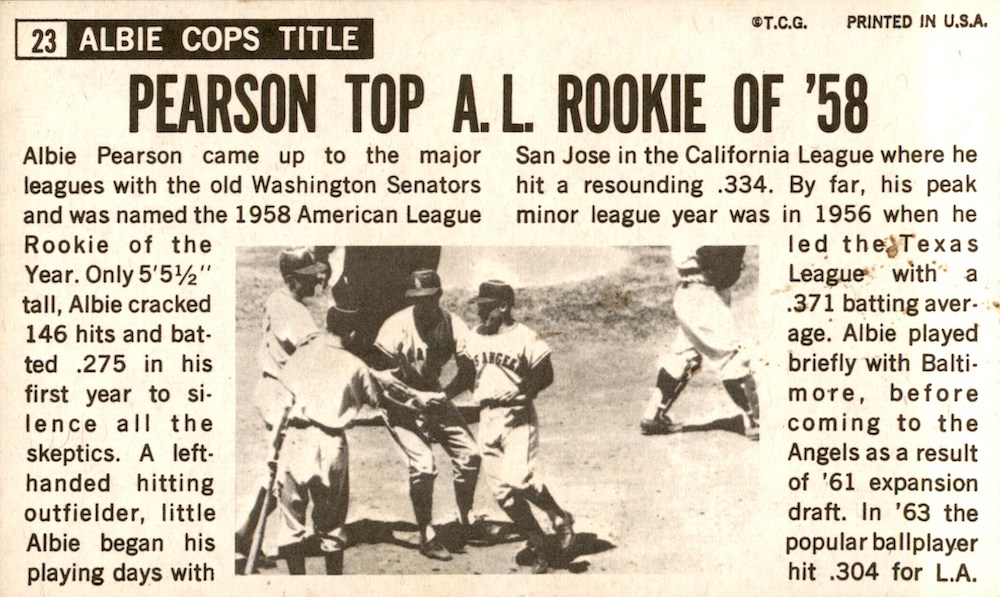


I like that they mention his height and weight. After looking him up, it seems that he was most notable for being a really small person playing professional baseball more than any single event or season. I tried to see if I could find an Albie Pearson and Frank Howard picture, or some other really huge player, floating around on the internet. Something similar to the Jose Altuve and Aaron Judge photos that pop up everywhere when the Astros and Yankees play.

I found nothing, so here is Aaron Judge and Jose Altuve. I am sure Frank Howard and Albie Pearson would have looked the same.   


Maybe taking pictures of extraordinarily tall players next to extraordinarily short players is more recent phenomenon.  

Next up, "The Turk". 


Farrell was a tall, hard-throwing relief pitcher for the Dodgers and Phillies for the majority of his career. However, the expansion Colt 45s selected him in the expansion draft and used him as a starting pitcher. He had some good years as a starter, but he later returned to the Phillies as a relief pitcher to end his career. Nice portrait photograph on the front of the card. 
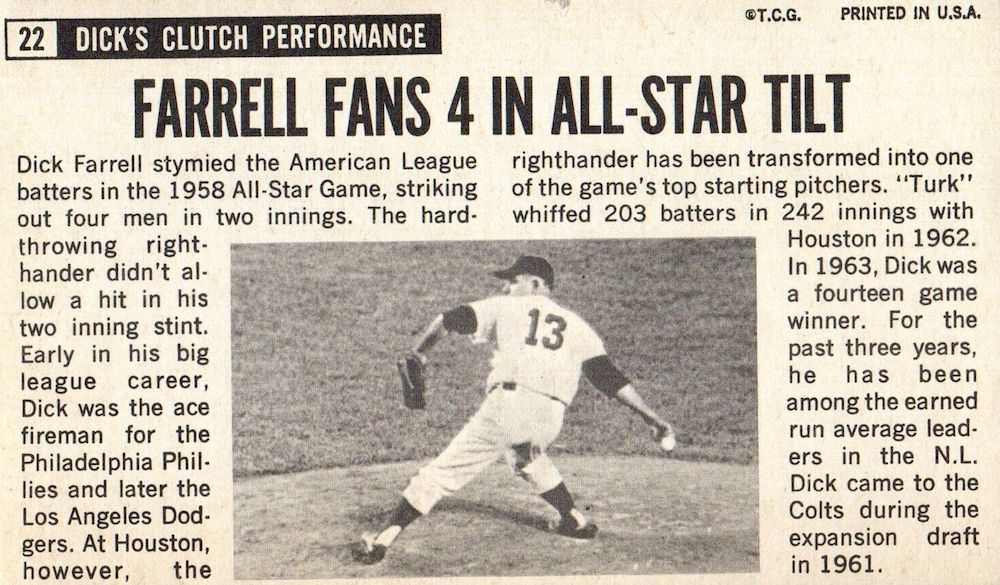


The centering on the back of the card isn't great, but I am going to live with it for the moment. The back describes his All-Star appearance in the 1958 game, which I thought was likely to be his career highlight.  It turns out that he actually ended up making the National League All-Star team 5 different times. Four of those were with the expansion Astros, so it could be that he was just the best player on those teams.   

Farrell's son, Richard Dotson, played for the White Sox in the late 1970s and 1980s. 

Another player I did not know much about.....


Chuck Hinton.

You should know this guy.  

He is actually a local player who went to high school in Rocky Mount, which is about an hour east of Raleigh. Hinton went to Shaw University, a small HBCU in Raleigh before he got drafted into the Army for Vietnam. Hinton had a late start to his career, reaching the Majors at the age of 27, but he was a good player for a short time. At the peak of his career, Hinton was a 20 steal, 20 home run player.  

Most importantly, Hinton founded the Major League Players Alumni Association after his career. There are people who, rather convincingly, argue that he is a person who should be in the Hall of Fame as a contributor to the game for starting up the Players Alumni Association. As the argument goes, he is likely tied to Curt Flood for admission into the Hall.  


Here is the back of the card, which spends most of the time talking about his Minor League career.  

Two cards left.  


Dick Ellsworth played during the 1960s, decent pitcher, but was always on the wrong teams. I kind of feel bad for him when I run into his cards. In 1963, Ellsworth went 22-10 for the Cubs. However, he also had a season where he went 9-20, another where he was 8-22. Not his fault. At one point in the late 1960s, Ellsworth ended up on the Red Sox. Otherwise, his career was spent with the Cubs (not good), the Indians (not good), and the Brewers during their first two years of existence (not good).   

Ellsworth played thirteen years and his career record is 20 games under .500. He also has a career ERA of 3.72. If he had been on good teams, you can imagine his career would have been a lot different. People who argue that wins is a misleading statistic sometimes use Ellsworth's career as an example. Decent pitcher with horrible results, largely due to where he played.  


The back of his card focuses on a one-hitter Ellsworth pitched against the Phillies in 1963. Not mentioned is the fact that Wes Covington bunted to break up the no-hitter. Also in the box score, this gem. Top line.  


The last card. 


Dean Chance won the 1964 American League Cy Young Award with 20 wins and an ERA of 1.65. He had some good seasons with the Angels and Twins, but not a very long career. He was much more noted for his off the field activities than his on the field activities at different points during his career, along with Angels teammate Bo Belinsky. After spending his 20s hanging out at the Playboy mansion, Chance spent his retirement working as a carnival operator.  


The back of the card is the standard with a short write up about a single game and a whole bunch of stuff about Chance's Minor League career.  

That's it, the entire 1964 Topps Giants set.  

Sunday, April 24, 2022

A Giant Update Part 12

I am getting so much closer. I had hoped to finish off my 1964 Topps Giants set on this post, but there will be at least one more after this one. Before this post, I was down to 14 cards to complete the set, with only one Hall of Fame player left to find. I also already have all the short-prints. Maybe at some other point in my life, I would have already finished this set. Between kids, work, and garage doors, there has not been much time to find new baseball cards.  

Here are the five new Topps Giants cards.

First up is Senators shortstop, Ed Brinkman.  


Brinkman was a really good defender, but was not much for hitting. He played more than 1,800 games in the Majors, but only had 1,300 hits. In 1965, Brinkman set an American League record for fewest hits in a season while playing in more than 150 games. He ended the year with just 82 hits and a .185 batting average.  

That's bad.  


The back naturally sticks to his defensive skills.  

I like that the card mentions his time as a member of the Raleigh Capitols. 

Next up, Mets infielder Ron Hunt.  


Did he cut himself shaving? That's a pretty wicked looking something underneath his nose.  


All this stuff on the back is impressive, but Ron Hunt is actually from St. Louis. He went to the same high school as Jerry Reuss, just a few years earlier.  

Next. 


Jim Fregosi was a favorite on the first Angels teams in the early 1960s. I knew him best as the manager of the Phillies when I was in middle school and high school. 


This is kind of a lame write up, considering that the Angels were in their third season when this card was produced.  I need to go back and look at my 1999 Devil Rays cards to see if they acknowledge Randy Winn's triples record for their franchise at the time. It's still 9th all-time in franchise history, but all of those higher triple total seasons belong to Carl Crawford.  

Next up is Ken Johnson.  


Before Edwin Jackson, there was Ken Johnson. He seemingly played on a different team almost every year in the 1950s and 1960s. Not really, but it was close. He played 13 seasons with 8 different teams. Considering the number of teams in the league during the 1950s and 1960s, that's a large number.  


The back of the card is interesting.

After reading about his no-hitter loss, I actually went and read a little bit more about his career. He actually seems like a decent pitcher who was on the wrong teams at the wrong times throughout his career.  

For example, he ended up on the Reds in 1961 and was given a rotation spot during the second half of the season. He went 6-2 with an ERA of 3 and helped them make the World Series versus the Yankees. If you are into sabermetrics, he had several 3 and 4 WAR seasons, just screwed over playing on bad teams. 

Last card is Leon Wagner.  


Leon Wagner was a really good player during the 1960s. His career got off to a slow start, otherwise he might have been a little more of a recognizable name. Wagner played college football and then ended up working at an auto manufacturing plant in Detroit while playing sandlot baseball.

The Giants signed Leon Wagner, but he drafted into the Army for the Korean War. 

Leon Wagner returned to the Giants, but was blocked by Willie Mays, Felipe Alou, and others. 

The Giants traded him to the Cardinals, but he was blocked by Stan Musial, Curt Flood, and Joe Cunningham.  

The Cardinals traded him to the Toronto Maple Leafs, the baseball team in the International League.  

The Maple Leafs traded him to the Angels where he finally got to play as a regular at the age of 27.  

Back of the card.  


Once Leon Wagner started playing, he was really good.  He made a few All-Star Games, hit 30 home runs a few times, and received MVP votes in several different season. It's too bad the Giants or Cardinals did not have an open outfield spot while he was a little younger.  

Updated checklist.

I am getting closer.  

1 Gary Peters
2 Ken Johnson
3 Sandy Koufax SP
4 Bob Bailey
5 Milt Pappas
6 Ron Hunt
7 Whitey Ford
8 Roy McMillan
9 Rocky Colavito
10 Jim Bunning
11 Roberto Clemente
12 Al Kaline
13 Nellie Fox
14 Tony Gonzalez
15 Jim Gentile
16 Dean Chance
17 Dick Ellsworth
18 Jim Fregosi
19 Dick Groat
20 Chuck Hinton
21 Elston Howard
22 Dick Farrell
23 Albie Pearson
24 Frank Howard
25 Mickey Mantle
26 Joe Torre
27 Ed Brinkman
28 Bob Friend SP
29 Frank Robinson
30 Bill Freehan
31 Warren Spahn
32 Camilo Pascual
33 Pete Ward

34 Jim Maloney
35 Dave Wickersham
36 Johnny Callison
37 Juan Marichal
38 Harmon Killebrew
39 Luis Aparicio
40 Dick Radatz
41 Bob Gibson
42 Dick Stuart SP
43 Tommy Davis
44 Tony Oliva
45 Wayne Causey SP

46 Max Alvis
47 Galen Cisco SP
48 Carl Yastrzemski
49 Hank Aaron
50 Brooks Robinson
51 Willie Mays SP
52 Billy Williams
53 Juan Pizarro
54 Leon Wagner
55 Orlando Cepeda
56 Vada Pinson
57 Ken Boyer
58 Ron Santo
59 Johnny Romano
60 Bill Skowron SP

Sunday, March 13, 2022

A Giant Project Update #11

This is the giantest of Topps Giant updates. It has taken me awhile to assemble this set. Long than I thought, but I think that it actually helped to collect the tough short-prints and expensive Hall of Famers first. Since my last update in February, I have been able to find another 8 cards to cross off the checklist. Yes, there are short-prints in this post and Hall of Famers, but most were nowhere near the cost of the Mantle and Mays cards.

After my last post, I was closing in on the 2/3 mark for the set with 37 of the 60 cards. In the last month, I have brought that total up to 45. 

A quick look at the new cards.

First up is Kansas City A's infielder Wayne Causey. 


This was one of the short-prints that I still had leftover on the checklist. Causey was a glove-first, light hitting utility infielder. There are multiple Hall of Famers in this post and Wayne Causey cost more than all of them combined. If I were not putting together the set, this is a card I would 100% not purchase. At those moments where I thought about quitting on this set, Wayne Causey always flashed through my head.  

"Would I buy a really expensive Mark Lemke card?"

I will get back to you. 


Wayne Causey's career year involved him finishing twelfth in the American League batting average leaders. I am not really sure that is the type of statistic and brag you want on the back of your baseball card.  I guess it's better than saying he finished 21st in MVP voting that season. I think Topps could have squeezed it in: 

"Wayne just missed out on the American League MVP in 1963, finishing just a mere 243 points behind Yankees catcher, Elston Howard" 


Yes, this card cost a fraction of Wayne Causey.

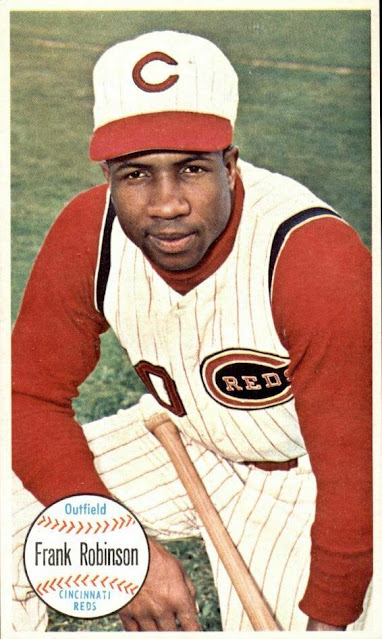
Frank Robinson.  


This Frank Robinson guy seemed really good. I am not going to go look it up, but the Reds would be foolish if they ever traded him.


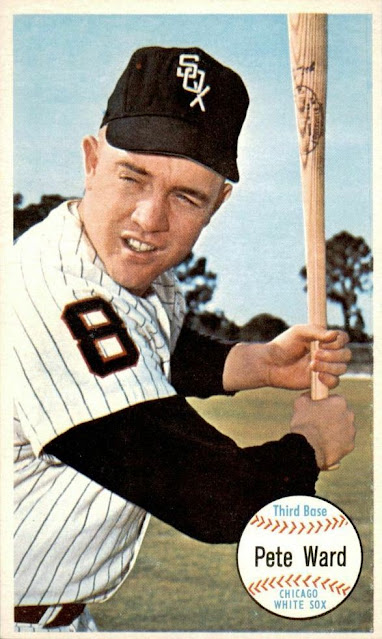
Pete Ward is an interesting player. He won the 1963 American League Rookie of the Year Award. Ward was a legit hitter with a .290s average, 25-30 doubles, and roughly 25 home runs in his first year or two in the Majors. He hurt his back and neck in a bad car accident after his second year and was never quite the same. Still, the guy is in the Canadian Baseball Hall of Fame. 


Ward still stuck around the Majors for a decade after injury, mostly with the White Sox. He played his last season as a left-handed bat off the bench for the Yankees. The back undersells his father a bit, which is the reason why I knew of Pete Ward before buying the card. 

Way back in the day, there was an antique store in my wife's hometown in northern Michigan that had a spattering of sports cards and memorabilia. It was next to the town's incredible coffee shop. One of the items in the store was an autographed photo and old O-Pee-Chee card of a Montreal Maroons hockey player, Jimmy Ward. I am not good with old hockey players, but the price for the two items was outrageous. 

I went home and Google searched the guy.  

Not mine, nor the items at the store, but he was a member of the popular 1934-1935 Montreal Maroons Stanley Cup winner.   


The card below is from Google. I don't buy hockey cards for hundreds of dollars. Nothing says popular Canadian sports star like appearing in an advertisement for syrup. Pretty dapper guy for a professional hockey player from the old days when they did not wear helmets. Although, maybe there is a reason his mouth is shut. 


Back to baseball cards.  


Not a Hall of Famer, but definitely a great of the era. I think he might have been one of the few players to appear for both the Minnesota version of the Washington Senators and the Texas Rangers version of the Washington Senators.  


The back describes his skill on the mound. His playing numbers are solid. 

Camilo was also a notable scout for the Mets, A's, and Dodgers following his retirement. Camilo convinced Cuban refugee Jose Canseco to sign with the A's, while also suggesting the team draft USC infielder/pitcher Mark McGwire. He also found a 15 year-old Tampa high school pitcher, Dwight Gooden, for the Mets. The majority of Latin American Dodgers players from the 1990s and early 2000s were discovered and signed by Camilo Pascal.  

Next. 


Heard this guy ended up on the Reds at some point. 


I hope the Orioles got a good return.  


The card is off-center. Although, in the grand scheme of things, this is a really inexpensive Roberto Clemente card. I might revisit this one at some point in the future. For the moment, I will take it.  


I feel the need to make a post ranting about Topps use of "Bob" in Roberto Clemente cards. 


Another really inexpensive Hall of Famer.  


Finally a Topps Giants card talking about an established Major League players Minor League career. This set has tons of cards were parts of the back are taken up by their Minor League numbers. This is the first card in this post. The PCL was serious baseball. The Sally League? Yikes. Someone was reaching.  

Final card.  


Dodger great Tommy Davis.  


Yes, Tommy Davis has two batting titles and helped get the Dodgers to the World Series, but here is something about his time with the Spokane Indians. 


Eight more cards crossed off and I am at 75% of the set. Two Hall of Famers left and no short-prints. 

1 Gary Peters
2 Ken Johnson
3 Sandy Koufax SP
4 Bob Bailey
5 Milt Pappas
6 Ron Hunt
7 Whitey Ford
8 Roy McMillan
9 Rocky Colavito
10 Jim Bunning
11 Roberto Clemente
12 Al Kaline
13 Nellie Fox
14 Tony Gonzalez
15 Jim Gentile
16 Dean Chance
17 Dick Ellsworth
18 Jim Fregosi
19 Dick Groat
20 Chuck Hinton
21 Elston Howard
22 Dick Farrell
23 Albie Pearson
24 Frank Howard
25 Mickey Mantle
26 Joe Torre
27 Ed Brinkman
28 Bob Friend SP
29 Frank Robinson
30 Bill Freehan
31 Warren Spahn
32 Camilo Pascual
33 Pete Ward

34 Jim Maloney
35 Dave Wickersham
36 Johnny Callison
37 Juan Marichal
38 Harmon Killebrew
39 Luis Aparicio
40 Dick Radatz
41 Bob Gibson
42 Dick Stuart SP
43 Tommy Davis
44 Tony Oliva
45 Wayne Causey SP

46 Max Alvis
47 Galen Cisco SP
48 Carl Yastrzemski
49 Hank Aaron
50 Brooks Robinson
51 Willie Mays SP
52 Billy Williams
53 Juan Pizarro
54 Leon Wagner
55 Orlando Cepeda
56 Vada Pinson
57 Ken Boyer
58 Ron Santo
59 Johnny Romano
60 Bill Skowron SP


106.

Blake Snell number 106 is just a red herring to make two other announcements.      Announcement #1- I have not written very often in this sp...