Tuesday, January 15, 2013

2010 Bowman Platinum Chris Archer Autograph

Last summer was a rough year for the Durham Bulls and a tough year for me to add Durham Bulls cards to my collection.  Two different times last summer I added Durham Bulls cards and the players were traded shortly afterwards.  The team also had a gaggle of AAAA players like Rich Thompson, Jesus Feliciano, Juan Miranda, and many others.  Sometimes, AAAA players can become fan favorites, but last year's crop gave fans in the Bull City little joy.  The prospects offered little hope too outside of the team's star hurler, Chris Archer.

2010 Bowman Platinum Chris Archer Autograph

The Rays acquired Chris Archer, and a few other players, from the Cubs for Matt Garza.  At the time of the trade Archer was playing in AA, but made it up to AAA last year to play for the Durham Bulls.  The move was really cool for Archer since he is a North Carolina native and grew up in Clayton, NC which is about 45 minutes east of Durham.  Archer made an appearance for the Tampa Rays last year and went 1-3 with an ERA of 4.60.  However, Archer was able to strikeout 36 batters in 29 innings while walking just 13.  In fact, many believe that the Rays liked Archer's pitching so much last year that it helped the team trade James Shields to the Royals for several top prospects including Wil Myers.  I will enjoy adding this card to my collection and am hoping for a better year of collecting Bulls cards.  

30 Year Top 50: 2000 Fleer Greats of the Game

#9- The second entry from the Greats of the Game line comes in one spot ahead of the original set.  There aren't many things to complain about with the original set, but Fleer did a great job of making the second run of this set even better.  Let's start with the best set.  The original Greats of the Game set was tied to the photography and covers of Sports Illustrated.  The 2000 set dropped the Sports Illustrated name and featured a much simpler base card.

2000 Fleer Greats of the Game Ralph Kiner Autograph

The older players in the base set were pictured in black and white photos and the more modern players were pictured in color.  The simple border and picture made the clean design of these cards a favorite of mine.  The borders of the cards were susceptible to dings and chipping making the base cards a condition sensitive set.  

2000 Fleer Greats of the Game Dale Murphy

If you compare the edges of the Dale Murphy card below to the Ralph Kiner card above you can see the slight white dings along the edges of the Murphy card.  When I first opened a box and a few packs of these cards back in 2000 I was able to complete an entire base set.  However, it took my another year to complete a mint version of the set.  The single cards can be found for less than dollar on the secondary market, but many have the same problems as my Dale Murphy card.  

2000 Fleer Greats of the Game Red Schoendienst Autograph 

One of the biggest changes in the 2000 set is the autograph insertion rate.  The 1999 set featured one autograph per pack, but the 2000 set featured one autograph per six packs, or four per box.   Fleer issued a total of 93 autographed cards, but Fleer offered little details about short prints.  It's widely believed that several cards in the set are harder to find then others.  A few of the cards were purposely shirt printed, but others were signer created short prints.  For example, Dave Concepcion signed his cards in both red and black ink even though the signers in the set were all provided black pens.  

2000 Fleer Greats of the Game Bruce Sutter Autograph

Overall, the quality of autographs was spectacular.  The plain design of the cards lent for an excellent space for the players to sign, as opposed to the 1999 set which featured a small white square with a Sports Illustrated Cover or Photograph.  Fleer did a great job of getting a wide variety of different signers for the set.  This Bruce Sutter autograph is one of my personal favorites.  While Sutter has had several different certified autographs over the years, this was the first one I ever owned.  Love the picture with the polyester Braves uniform and the shaggy beard.  

2000 Fleer Yankee Clippings Willie Randolph Jersey

Beyond the base set and great autograph set in the 2000 Fleer Greats of the Game set, collectors also flocked to this set for the Yankee Clippings jersey cards.  The 15 card set featured a variety of great Yankees players from different periods of time.  When the 2000 Greats of the Game set was first released this cards were hot sellers and could easily push the autographed cards on price.  As time has passed, some of the lesser stars in the set have become easier and cheaper to find.  My Willie Randolph card is my only Yankee Clipping card and cost me right around $10 shipped last summer.  


Sunday, January 13, 2013

2012 Playoff Prime Cuts Carlos Rodon USA Baseball Jersey/Autograph

I invested a little bit in the future of my card collection during the past week when I added an autograph of pitcher Carlos Rodon.  Not sure who that is?  Let me give you a little background.  Rodon spent this past baseball season pitching for the NC State baseball team.  Not your usual baseball powerhouse, except Rodon had a remarkable season last year.  The list of honors Rodon earned after one of pitching at the college level:

-Finalist for the Golden Spikes National Player of the Year
-Consensus First Team All-American
-Louisville Slugger and ACC conference Freshman of the Year
-ACC Pitcher of the Year
-Named the Top Prospect on the USA Baseball College Team
-Lead the ACC in ERA, Innings, Complete Games, and Opponents Batting Average
-3rd Nationally in Strikeouts and 3rd in ERA

Rodon will probably play at State for at least two more years and will then probably be a high draft pick.  While there is no guarantee that Rodon's success will translate into stardom on the next level, I am willing to take that risk for $15.

2012 Panini Prime Cuts Carlos Rodon USA Baseball Jersey/Autograph 


While I haven't collected any Panini products during the past year I am really impressed by the USA Baseball cards in the Prime Cuts set.  The signatures are all on card and they all feature a nice square of jersey.  In my opinion, these are one of the better USA Baseball sets of all-time.  Panini has taken some of the best attributes used by Upper Deck and Topps over the past few decades and combine them all into one set.  I will be on the lookout for a few more of these great cards to add to my collection.  


Saturday, January 12, 2013

30 Year Top 50: 1999 Sports Illustrated Greats of the Game

#10- I already did a write up about this set during the past fall that involved old men in card shops around St. Louis telling the same story about buying boxes of the 1999 Sports Illustrated Greats of the Game.  Basically, the boxes were either hot, meaning you landed several really great autographs, or cold meaning you just wasted $200.  While there had been other baseball card products that featured a per pack autograph, the Greats of Game set focused exclusively on retired players, with many of the set's signers being notable names.


1999 Sports Illustrated Greats of the Game Steve Carlton Autograph


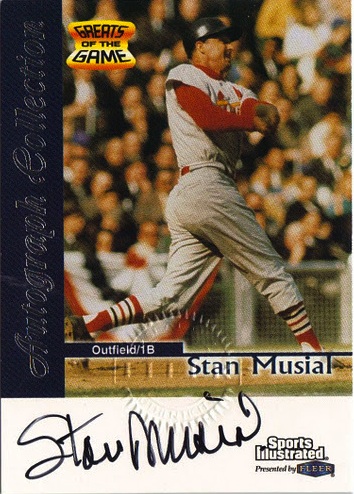
While there was a base set of unsigned cards featuring Sports Illustrated covers and photographs, the main focus for most collectors were the autographs.  The autographs all generally follow the format of the Steve Carlton autograph above.  The main picture on the card were either a Sports Illustrated cover, or a picture from a Sports Illustrated magazine.  The bottom of the card featured a white box where the player was supposed to sign and the side of the card always had a blue strip with the words Autograph Collection running bottom to top.  


1999 Sports Illustrated Greats of the Game Bob Gibson Autograph


As previously mentioned, the autographs in each box ran hot and cold.  Some boxes would yield a high number of high end hits featuring premier Hall of Famers such as Nolan Ryan, Hank Aaron, and Willie Mays.  However, Fleer did a great job putting together a great list of signers for this set making sure that the checklist for each team was deep.  Most teams have multiple Hall of Fame signees and a wide range of other interesting names available.  For example, my Cardinals have the usual group of players that you would expect to appear in a set featuring the Greats of the Game.  


1999 Sports Illustrated Greats of the Game Stan Musial


However, they made sure to also include players with significance that would be highly collectable among the teams fan base.  Some of the players who signed for this set have few autographs out on the market making their autograph in this set highly desirable.  For the Cardinals, this set is home to the only certified autograph of pitcher Bob Forsch.  Certainly not a Hall of Fame player, but he had a long career with the team and pitched two no-hitters.  For a Cardinals fan this is a great card to pick add to your collection, but that can be said of many of the cards in this set.  


1999 Sports Illustrated Greats of the Game Bob Forsch Autograph


This set is a classic of the past 30 years and is a fun set to track down.  Especially the autographs.  While some of the higher end autographs have dried up on the secondary market there are still some really good autographs floating around at great prices.  One of the hidden gems of the set is the Chicago Cubs team set which features seven autographs, but five of them are Hall of Famers.  All five of the Hall of Famers: Fergie Jenkins, Ernie Banks, Andre Dawson, Ron Santo, and Buck O'Neil can all be found pretty easily and will most cost less than $25 on a good day.  Banks might be a little pricey.  Whatever your team, or player, these are fun to find.  

A little hint on my next set?  This isn't the best Greats of Game set. 


Friday, January 11, 2013

2012 Topps Pro Debut Tim Beckham Patch Card

One of the most underrated products put out by Topps the past three years has been the Pro Debut set.  It's the second minor league based set issued every year by Topps and has also been joined by the Topps Heritage Minor League set.  While the Bowman set features minor league prospects on the cards, the pictures of the players are all of them wearing their major league uniforms.  The Pro Debut set and the Heritage minor league cards feature players in their minor league uniforms and borrow the card designs from the current year's Topps design for the Topps Pro Debut set, and the current year's Topps Heritage design for the Heritage Minor League.


One of the coolest features in this year's Pro Debut set was the inclusion of manupatches.  The patches featured the cap logos of various different teams throughout the minor leagues.  I was excited to see a Durham Bull's player was included in the set earlier this summer and quickly set out to add this card to my collection.  However, once I started looking for the card I found only a small supply of the cards and learned that Topps set the insert ratio for the manupatches at roughly two per six box case.  Tough odds to say the least.  I set out to win this card in an auction or trade for one.  The trade market however was dry and the bidding was competitive and often stretched to the neighborhood of $20 which is pricey for a manupatch.  I decided to be patient with the card and wait until I found the card on my terms which happened last week when I found the card on COMC for $5.  

The Best of the Bulls

I have been spending part of my winter holiday reading and relaxing and came across a cool blog post a few days ago over at Watching The Durham Bulls about the greatest Durham Bulls players of all-time. I really enjoyed the reading and debate surrounding the posts and spent a little bit of time the last few days tackling the question myself.  No baseball cards right now.

So, here's how I tackled this questioned:  I took over 100 years of Durham Bulls baseball, all the players, and crunched the numbers a bit.  At first, I started looking at the player's performance while they were in Durham.  After a few minutes I wasn't sold on the player's actual performance in Durham being the best measure of the players.  After all, Evan Longoria has a .245 career batting average for the Bulls over 45 games.  First, I don't think of Longoria as a .245 hitter.  Second, given that he's one of the best third baseman in the American League, there is probably a reason he was only in AAA for part of a season.

Here's what I decided.  The purpose of players, generally in AAA, is to prepare to take the last step to be Major Leaguers.  There are also players who are not in the Majors, have been in the past, that are trying to revive their careers or might even serve in some type of mentoring role for the younger players.  Ultimately, they all want a ticket to the Majors and they want to perform the best that they can when they get there.  So, I tackled this issue based on how well the players performed once they reached the majors.  The players I looked at generally made their appearances for the Bulls at the beginnings of their professional careers.  An older player, such as Norm Charlton, might have had an impactful Major League career, but not had an impact after being on the Bulls.

I broke my list into a position players list and a pitchers list.  Enjoy!


Top 5 Durham Bulls Position Players 

I used a couple of different measures to look at the former Bulls players for my list.  One of my main measures was the use of OPS+ which is a statistic that looks at the amount of times a player gets on base and their slugging percentage.  OPS+ also takes account factors, such as different ballparks, which could skew a players numbers.  OPS does not do that.  An average player would have an OPS+ of 100 while better players drift upwards towards 200.  Babe Ruth has the highest career OPS+ around 206.  I also took into account other career statistics and awards.  


1.  Chipper Jones- While Chipper is not in the Hall of Fame, he will be in once he is eligible.  I think.  Over a 19 years career for the Atlanta Braves Chipper Jones posted an OPS+ of 141, hit over 450 career home runs, while posting a batting average over .300.  Chipper Jones also won the 1999 National League MVP award, was named an All-Star eight times, and was apart of numerous post season teams including the 1995 Braves team which won the World Series.


2.  Joe Morgan - The only Durham Bulls player to ever be named to the Hall of Fame, Morgan is considered by many to be one of the greatest second baseman of all-time.  His 22 year career was primarily spent playing with the Houston Astros and Cincinnati Reds, but also appeared at the end of his career with the Phillies, Giants, and A's.  Morgan has an OPS+ of 136, but to his credit was very productive getting on base.  He tallied just over 2,500 hits in his career, but also walked 1,800 times giving him an OBP of almost .400.  He lead the league in that category several times.  Morgan also hit over 250 home runs and stole almost 700 bases.  Morgan played on two World Series winners with the Reds, won 5 Gold Gloves, and was named to 10 All-Star teams.  


3. Evan Longoria- While Longoria's career has just started, and his over all career numbers don't match up to Morgan or Chipper, he has the potential to their equal if career continues at it's current pace.  He's already been named the American League Rookie of the Year on 2008, been named to 4 All-Star teams, and won 2 Gold Gloves.  His OPS+ is currently 137+ which is just a hair better than Morgan's.  Also, a quick glance at his Baseball-Reference page shows his comparable players through age 26 include Chipper Jones, Gary Sheffield, and Jim Thome.  Not bad company.  I realize the top of the list has Bob Horner and Scott Rolen, but both of those players were Hall of Fame potential early in the career.  Horner had a sudden and sharp decline while Rolen has had injury problems.


4. David Justice - Justice played in the Majors for 14 seasons between 1989 and 2002 playing for the Braves, Indians, Yankees, and A's.  He appeared in six World Series during that time: three with the Braves, one with the Indians, and two with the Yankees.  Justice won the 1990 National League Rookie of the Year, won the LCS MVP in 2000 with Cleveland, and was also named to three All-Star teams.  Justice is never going to be in the Hall of Fame, but he was an above average Major League player.  He ended his career with over 300 home runs, 1000 rbis, a slugging percentage of .500, and an OPS+ of 129.


5. Rusty Staub- Le Grand Orange gets the last spot on my list.  Rusty Staub is a little bit hard to judge as player.  In my opinion, he probably stuck around a few too many years at the end of his career.  However, if someone is willing to pay you to play baseball who am I to argue.  Staub had an OPS+ of 124 to go along with almost 300 home runs and 500 doubles.  He appeared in six All-Star games over his 23 year career that featured appearances with the Astros, Expos, Mets, and Tigers.  


Top 5 Durham Bulls Pitchers 


The pitchers were a little bit trickier to rank than the hitters.  The Bulls basically have two Hall of Fame position players and one potential Hall of Famer.  The other two players on my top 5 position players list were very good everyday Major League players.  The pitchers list really has one clear cut best pitcher, one potentially great pitcher, and several solid Major League hurlers.  


1, Mickey Lolich - I was really surprised by the career totals of Lolich when I looked him up a few days ago.  I grew up in St. Louis around Cardinals fans and always knew Lolich as the pitcher that beat Bob Gibson in Game 7 of the 1968 World Series.  To hear most Cardinals fans talk of the pitching match up, they describe Lolich as a David and Gibson as a Goliath.  In actuality, the pitching match up was much better than described.  Lolich won more than 200 games in his career and almost reached 3,000 strikeouts.  During the 1971 and 1972 seasons Lolich paced the Tigers with 22 and 25 wins while striking out 558 batters during those two seasons.  Lolich won 3 games in the 1968 World Series and was awarded the World Series MVP


2. David Price - I am putting Price second on my list despite the fact that he hasn't played a really long time.  Price definitely has the potential to be the equal of a pitcher like Lolich or maybe even better.  Price has now played for the Rays for three full seasons and parts of two others.  During that time he has already won 65 games, struck out 200 hitters twice, won a Cy Young, and been named to three All-Star teams. Not a bad start.  


3. James Shields- I was a little sad to see Shields get traded this off season, but the Rays got a good return for him.  Shields isn't the equal of Price, but he is an above average Major League pitcher.  He throws a lot of innings, over 200 six times, and is a consistent winner.  Over seven seasons Shields has won 87 games with double digit totals in six of the seven years.  He has also gone over 200 strikeouts twice and finished third in the Cy Young in 2011.  


4. Jason Schmidt- Schmidt's final career numbers aren't spectacular, but for a very a few years he was a really good pitcher.  I remember watching him pitch the second game of the NLCS in 2002 for the Giants, playing the Cardinals, and thinking it was one of the better post season pitching performances that I had ever seen.  During his six seasons on the Giants he won 78 games and averaged more than a strikeout per inning during that time.  He also made two All-Star teams and won a ERA title in 2003.  


5. Kevin Millwood - Millwood makes my list as a solid Major League pitcher.  He had some good years, he had some bad years, and more importantly a few nice moments.  First, Millwood has 16 years in the Majors and was still active last year.  During that time he has recorded 169 wins for the Braves, Phillies, Indians, Rangers, Rockies, and Mariners.  He won the American League ERA title in 2005 and pitched a no-hitter once for the Phillies.  Last season he passed 2,000 strikeouts for his career.  


Thursday, January 10, 2013

30 Year Top 50: 1984 Fleer Update

#11-After yesterday's Hall of Fame shutout this post might be opening a fresh scab for some, but it's just the day I happened to land on this set.  The 1984 Fleer Update set is considered by many to be one of the two best update sets of all-time along with the 1982 Topps Traded set.  However, I did not collect cards in 1982, so that set is not apart of my countdown.  In fact, this set was Fleer's first attempt to create an update set.  While it is exactly the same as the 1984 Fleer base set in terms of design, the set hit two home runs on its player selection.


1984 Fleer Update Pete Rose 


The 1984 Fleer Update set is the home to the first Kirby Puckett and Roger Clemens rookie cards.  I know we, as a hobby, have confusion over what is a rookie card, an XRC, and what other labels a certain Dallas-based magazine has floated out there throughout the years.  Both cards were the first issue of both player and are treated that way by collectors.  While I do own this set, I actually prefer the Pete Rose Expos card over both the Clemens and Puckett cards.  Nothing against Clemens or Puckett, but I've always thought it was cool to see Charlie Hustle wearing the Expos uniform.  I am sure that the Pete Rose Expos cards should get a cult following like the Piazza Marlins cards.  


1984 Fleer Update Roger Clemens

Now, I am not here to debate the steroid issue in baseball.  Just talking about the cards.  The Clemens rookie card is the most important card in this set and is treated like his true rookie card by collectors.  Despite the controversy surrounding the former pitcher, this card still frequently sells for over $100 both raw and graded copies.  Graded copies with high grades can still approach $500.   This card is also one of the most forged cards out on the market, so beware of who and where you pick up a copy of this card.  While the card is still over $100, at the height of its popularity it frequently crossed $200 all the way up to $250.  It just hasn't fallen as far as other controversial players like Mark McGwire in terms of card value.  


1984 Fleer Update Kirby Puckett 


The Kirby Puckett card is the token Hall of Fame card on this blog post.  Raw copies of the Puckett rookie card can be found for around $75 to $80 with graded copies crossing into the hundreds of dollars.  A high graded copy of this card might fetch more than $250 to $200.  Besides having a nice Kirby Puckett autograph, this is a must have for any Puckett collector.  


106.

Blake Snell number 106 is just a red herring to make two other announcements.      Announcement #1- I have not written very often in this sp...